


Ask a Christian Witch: Spirit Guides, Doing Research, and Messy Saints

It's Q&A time again already!

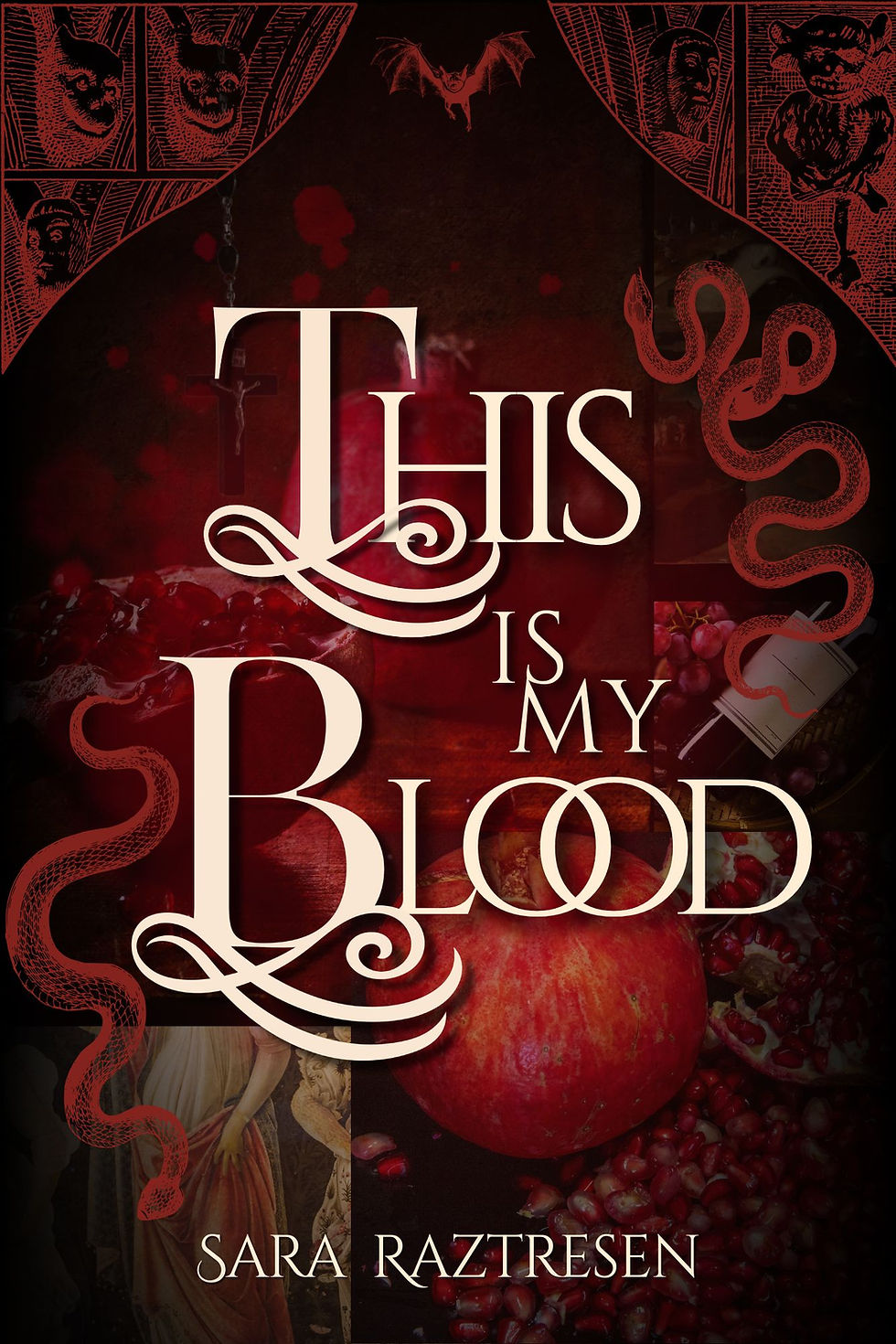
Because my latest book, This is My Blood, is finally here!
This book released on July 31st, 2026, and it is everything I wanted it to be. It was so much fun, and it brought me so much joy to write it, and so far, people are enjoying it already!
If you haven't gotten a copy yet, definitely consider checking it out—especially if you love stories about angels, demons, vampires, witches, and God Himself lol.
Anyway, here we are with July's questions (technically in August). July sure as hell was not any quieter than June, but it did give me some time away from writing that'll help me get my head on right for my next project, at least.
And remember, if you have questions, there's a Google form!
Now let's get into all this good conversation!
Can We Have Spirit Guides?
I was wondering your thoughts on spirit guides or familiars. Is it okay to have them? Is it wrong? Thank you for your time! —Anonymous
Hi, there!
When it comes to spirits, I treat them the same way I would treat people. So when I see your question, it reads to me like:
What are your thoughts on people? Is it okay to have friends? Family?
If the answer to that question is yes, then it would follow that spirits and spirit guides would be the same. Spirit guides can be many things: your guardian angel (which everyone has), or an ancestor coming to give you advice, or even nature spirits you might make friends with. The only thing to be mindful of is to not go taking advice the spirits give that would put you in conflict with your ethics or with what God wants for you. In the same way, you would also be careful not to go follow your friends' lead when you were a kid if they were asking you to do things you knew your parents forbade.
Familiars, too, are often just animals you've created a special bond with spiritually. Most people end up with one of those, or with a "heart animal" that feels like a truly deep bond. My pigeon, Bilok, is definitely a familiar in the sense that he always seems to know what I need to be doing spiritually (as he gets all up in my business when I get distracted during tarot with God lol).
How Do We Decide What is Mistranslated or Not in the Bible?
I am reading Discovering Christian Witchcraft and was looking for help on reconciling some thoughts I have. Specifically I have asked my self questions about the bible being translated wrong prior to reading this and that sounds logical to me but also deciding that some of the bible is not correct is like a license to just do what ever you want.
Like for instance there ARE bible verses that say to avoid looking to the heavens for answers. Its not just a stupid distraction. But I would imagine you would say those are the parts of the bible incorrectly translated? So going forward I am not sure how to navigate my path. Thanks. —Amanda
Hi, Amanda!
So... this question intrigues me, because it suggests that the way people decide things are mistranslated is a matter of convenience or comfort, and not a matter of scholarship and truth seeking. But if we truly care about God's word, and His decrees for us... shouldn't we do everything we can to not just take an English translation at face value based on our understanding, but dig into the context to understand the author's intent, too?
Because I don't look at things that make me uncomfortable in the Bible and just decide it must've been written wrong. I go and look into it deeper: into the history of the time period, who wrote the book I'm reading, what specific Greek or Hebrew words were used, the context of those words in their proper sociopolitical setting, the neighboring nations and other religious practices of the area the writers could've been observing or talking about, and so on.
To use your example, though, let's take a look at where these ideas about astrology crop up. One is in Deuteronomy 4:19:
And when you look up to the sky and see the sun, the moon and the stars—all the heavenly array—do not be enticed into bowing down to them and worshiping things the LORD your God has apportioned to all the nations under heaven.
We also have Isaiah 47:13:
All the counsel you have received has only worn you out! Let your astrologers come forward, those stargazers who make predictions month by month, let them save you from what is coming upon you.
The answer is no, actually. Even with the English translation in front of me, I wouldn't say the verses telling us not to look to the heavens or that the astrologers are useless are mistranslated. They're not. They say what they mean to say: we shouldn't be deriving our decision making power from the celestial bodies, or act as if our fates are set in stone by them to the point that we can just predict everything that goes on with perfect accuracy.
What I would say is that this verse makes perfect sense in context with the times they are written. For example, Deuteronomy wasn't written by Moses; it was written by the scribes of King Josiah, who had it commissioned as essentially a cultural counter-charter to the aggressive push of the Neo-Assyrians and Akkadians, who were trying to encroach on Israelite land and fuse their culture with the Israelites. This syncretism stood to erase what was culturally distinct and special about Israelite culture, hence this part of Deuteronomy re-affirms: the Israelites worship the Creator of all things, not the things that He created. They are a monotheist culture in an area that was still largely polytheist and personifying the sun, moon, and stars as separate deities.
Likewise, with Isaiah, this was a prophet writing in the times of the Israelites' exile into Babylon. Babylon at this time was under the faith of Zoroastrianism, which had heavy influence on Jewish thought in terms of things like heaven and hell, and even astrology. However, the Zoroastrian priests and astrologers were very fatalistic about astrology; they believed that if the stars were in a certain position, that fate was unchangeable. If you were an Aries, for example (born under the Ram), you were doomed to be hotheaded, impulsive, violent, and destructive. But Jewish cosmology and philosophy, which still hinges on the fact that God gave us free will, tells us that not only does our free will unbind us from the threads of fate, but also that if God wills it, He can change the script and the fate His celestial bodies imprint on the world at any time. Nothing is set in stone. God's will (and our will) do not make astrology foolproof, as the Zoroastrian astrologers believed it was.
If you read our work, Discovering Christian Witchcraft, and see the scholarship Mimi and I put into decoding these verses, digging into their context and language and history and surrounding ideas, then you see exactly what kind of work is required to understand this text to its truest essence. To simply decide that things that you don't like are mistranslated is wrong. Facts and proper theological reasoning take precedence above all else, and especially above our own opinions.
There is never a time in your work with the Bible that you should just be going off what you want and not the actual evidence we have available to us. By remembering this, you should be able to avoid falling into the trap you're worried about here.
Is Lucifer Real? Who Actually is "Lucifer"?
Hi Sara! I have a question about the origins of Lucifer. I’ve seen numerous sources say that Lucifer isn’t actually in the Bible or any Christian texts, but many people who work with him typically view him from that lens. Instead, they say Lucifer is strictly the Roman god. Knowing that you work with him, or at least have worked with him, I’m wondering what conclusion you’ve come to about his origins. I hope you’re doing well and having a great summer! —Anonymous
Hey, there!
So, these people you're hearing from aren't necessarily wrong. Lucifer is, in fact, a Roman deity of the morning star (which is actually the planet Venus, but we see as the first star that happens in the morning sky; it is the "star" of the dawn, which many deities, like Zorya, are named after). However, in the Bible, Lucifer is also a title.
This title shows up in two places: one, in reference to the Babylonian king Nebuchadnezzar (Isaiah 14:12) and the other, in reference to Jesus (Revelation 22:16). Both times, they are simply said as morning star, the Latin translation of which is Lucifer.
Usually, what happens is that people treat the title Lucifer as synonymous with "the enemy" or "Satan" (Ha-Shatan) or "the Devil." This is largely because of a few different cultural influences over time, one of which was the famous poem Paradise Lost by John Milton, where Lucifer is mentioned (ironically alongside Satan or as Satan lol):
Know then, that, after Lucifer from Heaven
(So call him, brighter once amidst the host
Of Angels, than that star the stars among,)
Fell with his flaming legions through the deep
Into his place, and the great Son returned
Victorious with his Saints, the Omnipotent
Eternal Father from his throne beheld
Their multitude, and to his Son thus spake.
Problem is, though, that Paradise Lost is fanfiction. It's not biblical. It's a poem first published in like, 1667.
Another place we see Lucifer and Satan get their wires crossed comes earlier, though, from St. Thomas Aquinas's massive work, Summa Theologicae:
Lucifer who became Satan, leader of the fallen angels, wished to be as God. This prideful desire was not a wish to be equal to God, for Satan knew by his natural knowledge that equality of creature with creator is utterly impossible. Besides, no creature actually desires to destroy itself, even to become something greater...
Which I would venture is where Milton got his ideas for his poem from. However, the problem with this is that it's just... wrong. Ha-Shatan means "the Adversary"; it's a title of an angel of God meant to test us the way a prosecutor pokes at a defendant in court. Over time, Satan became his own literary figure vs. any anonymous angel working the job, but that doesn't make Satan some rebellious angel like these thinkers posit, nor does it link him with any Lucifer, which isn't the name of any angel in the Bible.
Knowing that Lucifer is a title, though, in my own work, I've discovered an angel that wears this title as a means of easily slipping between Heaven and Hell, and in my UPG (unverified personal gnosis), that angel is the archangel Samael. This makes sense because Samael is also the angel ruling the sefira of Jewish Kabbalah known as Geburah, which is the justice of God. Samael as a name means "Poison of God" or "Severity of God." Geburah as a sphere is thought to be the one that, when broken free of its tethering bond with the sphere of mercy, Chesed, causes its own problems and rifts in reality that create the dark side of life: the many worlds of demons that were deposited in the broken husks (Qliphoth) these spheres left behind. Through a struggling, volatile pocket of Geburah, one accesses the homes of demons (Hell).
Thus, Samael, who rules this sphere, wears the name Lucifer to switch between his role as God's punishing angel and emperor of the Other Side (Sitra Ahra) of these spheres.
Names are of great importance to angels and demons. They hold a lot of power. As such, certain angels and demons have been known to wear different names like masks, or to hide their names so that power can't be held over them. It's confusing mystical stuff that takes a lot of time to trace down, though—much like finding out someone's real identity in a detective case.
Resources for Someone Interested in Mysticism?
What are some good intro videos and books list for a 31 year old man interested in Christian Mysticism? —Brad
Hi, Brad!
I actually just posted a whole video about mysticism, what it is, and a list of sources! Check it out here. My YouTube channel has lots of videos like this that may be helpful to you and others, as well!
What Will A Hitchhiker's Guide to Hell Be Like?
Hi Sara. I was curious about how the format for your next book, A Hitchhiker's Guide to Hell will be like? Will the format be like the interviews you do, or like This is My Blood that came out on the 31st of July? —Anonymous
Hey!
This book is definitely going to be somewhere between This is My Blood and Where the Gods Left Off in form. I don't plan to put a bunch of tarot cards into it like I do for the latter, but as it's not highly academic like the Christian Witchcraft series, and it's more nonfiction like my interviews, it'll have a lot of story alongside practical information for folks looking to understand more about the Qliphoth and what a practical application of that journey looks like. It serves to make less abstract the whole journey, especially given so many books on the subject can be downright confusing to beginners!
How Do We Reconcile St. Hildegard's View on Women and the LGBTQ+?
I got into Hildegard von Bigen because of her theology and sciences. Apparently she condemned women sleeping with each other (or rather one woman taking on the man’s role in coitus). But apparently she may have had feelings for her closest confidant and secretary(?). How do we reconcile her homophobia with her love of women? I guess she was just a product of her time and found the act of a woman taking the masculine role awful in her visions, but praised women’s bodies in another. What are your thoughts? —Anonymous
Hello!
When it comes to figures like St. Hildegard, you really can't take these kinds of things that seriously. At the end of the day, Saint or not, she was a woman alive in the middle ages of what is present-day Germany. People are still homophobic and awful today, never mind 1,000 years ago. Saints absolutely are a product of their time, even if they have lots of mystical knowledge and direct experience with God.
The sociopolitical nature of sex and sexuality, especially regarding marriage, just was not like what it is today. Marriage was about power, social hierarchy (in the marriage and outside it), and legacy. People in the time of the Bible's writing, and for many centuries after, could not conceive of two people of the same gender loving each other as equals with no thought to who would inherit their lands or assets and keep it in the family. As such, it's not even really fair to hold people like St. Hildegard to the same standards we have now. We can just mark these things as a sign of the times and move on.
And I mean, shit, even for all the time I've spent with God, walking this path, I'm certainly not perfect, either. And I never will be. I can try all my life, but I'll never have a perfect personality. I'll still get angry, make mistakes, and form opinions based on incomplete information. The only thing I can do is try to be better with every day. For people like St. Hildegard, whose thoughts we have access to are static and can't be changed (because they're written down), we have to consider: would she have thought the same way in the modern era? Maybe, but maybe not. Does she think the same way now, with all illusions of the world and her own hang-ups erased in heaven?
From my conversations with Saints, heaven usually undoes all these illusions.
How Can We Hear God/Jesus/the Holy Spirit?
How does one “hear” God and know that its a direct answer from Him? Like when people claim God told them something or they heard a voice in their head? How does one meditate to communicate with Him/Jesus/H.S. so vividly, as you did for your interviews? The last thing I want is religious psychosis!
Also, I just want to say, genuinely from the bottom of my heart, thank you Sara. I’ve lost my faith for several years until I came across your channel and listened to what you had to say. Something about you and your interpretations give me peace and feel right, like I’m being brought back on the right path. —Hannah
Hi, Hannah!
First things first: thank you for your kind words! I'm glad my work could help you find your way back to a spiritual path you can grow with! ♥
Now, with that said, when I do my interviews, one thing I need everybody to understand is that I do not audibly hear or visually see any such entities. I don't see people standing in my living room, nor do I hear anyone as clearly as I might hear another human being. What I do experience is what is essentially the translation of energy into forms I can more easily understand (like speech, imagery, and sensation); this happens through deeply focused meditation and through a divination tool as an anchor, like tarot cards.
The anchor is important. It is all too easy, especially if you're inexperienced, to think you're hearing something from a spirit, only for it to be your own ideas overriding the meditation experience. While I can better grasp a spirit's meaning now vs. when I first started, I still use the cards as a concrete way to see that I'm not just inserting my ideas into the meditation space.
When I meditate, I also like to try and experience all the sensory details. If I imagine I'm standing on a grassy plain, I try to imagine what that grass feels like under my feet. If I see the trees swaying, I try to imagine what the breeze feels/smells like. I might touch a rock, or listen to birds, or whatever else, in order to stitch myself into the zone. All of these sensations come from my memory/knowledge of what these things should look/smell/feel/sound like, but they make it more concrete and easy to understand for me.
Deities and spirits know how to translate themselves into a form we can perceive and understand, and that's what these "little voices" are: they're the snatches of words, or the colors or feelings or smells or sounds, that convey what they're trying to express about themselves. As such, I have also learned not to fight what I see in meditation—to avoid saying "that can't be" or "they wouldn't say that" and just let whatever happens, happens, while checking with the cards I'm pulling. In doing this, I find I get a lot more interesting answers, because the spirits aren't filtering themselves, and neither am I.
It is difficult, and it can be overwhelming if you're not grounded. Scary things happen. You have to remind yourself that you're not actually wherever you see yourself in meditation, but actually in your house, perfectly safe. Otherwise, you'll be too scared to plunge into whatever you're seeing. Just take it slow and try to build your imagination skills before doing anything serious.
Have You Ever Spoken to St. Sebastian?
I'm not sure this is the correct place to ask, but I'm also not sure where else to do it, so if I'm wildly out of place just ignore this! I was wondering if you ever did one of your interviews with Saint Sebastian? I often wonder how he feels about the significance and role he acquired in queer/gay culture in recent times! —Ester
Hey, Ester!
I have, actually! It's right here on my Patreon. I'll give a little snippet of the conversation with him, especially as it concerns your question:
"As I said, my presence is a cover," he said with a shrug. "These arrows have come to mean many things: the sting of disease, the puncture of social scrutiny. All are welcome in Christ's arms, yet so many have been barred, wrongly detained, by those just as unclean and unworthy as those they claim are so much worse.
"I'll say again: this world is a hospital. It is not the job of the patients to play nurse or doctor. Let the gay men come to me. Let them use my body and my pain as a road to recovery. what has any patient to say about how a nurse or doctor treats a man in the bed next to him?" That flash of a Reddit post I saw on r/catholicism came up, how this poster was calling it "disgusting" that gay men had St. Sebastian as their icon and drew close to him, treating the sexuality itself as a disease in his language—and that had St. Sebastian frowning in front of me. He snapped, "What qualifies a patient to even diagnose what sin another man has in the first place when he can't even properly diagnose and accept treatment for his own? All need healing for reasons no one is entitled to know save patient and doctor. These are the ideals of the sick: to be angry, disgusted, at anything and everything except their own hypocrisy."
I blinked at him, unsure, because his language was vague. "So... the sexuality thing itself, you don't think—?"
St. Sebastian waved a hand, impatient. "Sexuality means nothing outside this world."
From what I understood, St. Sebastian was more than fine with his image being used as a shield, cover, and comfort for members of the LGBTQ+ community who see their own suffering (from social stigma, abuse, etc.) in St. Sebastian's wounds of martyrdom.
How Do I Know God Told Me to [Do XYZ]?
In contemplative prayer, I believe God told me to Stand up for the poor, the needy, the oppressed. How do I know this was God and not my own mind making it up? More importantly, how can I help those in need when I cannot go out to meet such people or do public social justice (life circumstances)? What are some good places to donate? Thank you! —Anonymous
Hey!
Well, between you and me, that sounds like a very God thing to say. I know that because I've seen that exact sentiment backed up in Scripture over and over, and because it matches precisely with the words of Jesus Himself. That's your best way to know that God is the one telling you to do something: if it actually matches the character we know of Him based on others' encounters with Him (Scripture, the Saints, etc.).
When it comes to donating, look into your local food pantries and food banks! Churches, too, often run feeding ministries that are always looking for donors and helpers.
How Do You Research Without Getting Overwhelmed?
There is so much to learn about God and witchcraft (deconstruction, appropriate worship, tarot, herbs, etc.); how do you handle the overwhelming amount of resources? The references in your book, Discovering Christian Witchcraft, are already pages long! —Rin
Hi, Rin!
It can get crazy when the research gets deep, yeah! But when I have a book like Discovering Christian Witchcraft, I'm actually segmenting my research by topic. I research enough to get a good background on something, then start writing, and if I discover I'm still missing information about a topic, then I go back and do some more research while I write.
Think of how college majors are structured. You don't throw a college freshman into their 400 level classes. You start them at the 100 level. What things are foundational for your craft? What things can you build on? Group them by topic, and then think about what starting point you need for each topic. If it's history of God, then you'd wanna start way back, in the Old Testament/pre-Abrahamic paganism area, and work your way up to New Testament/Greek stuff. If it's theology or mysticism, introductory/overview texts that they would use for intro to theology courses would help.
In fact, I actually look through the course catalogue for theology and philosophy programs and see what books they recommend for their intro students, and from there, I end up finding the names of all kinds of other philosophers and theologians I want to read about. For instance, I never would've heard about Hans Ur von Balthasar if I hadn't picked up The Strangest Way based on an intro to theology course!
Whatever topic you want to know about (history, theology, mysticism, philosophy, spell crafting, herbalism, etc.), ask yourself: what is the foundational knowledge you need to build up from? What basics need to be covered before more complicated stuff can be untangled? That's how we research.
Ask Your Questions!
Remember, all your questions can go to this Google form, so don't hesitate to reach out! I'm looking forward to seeing what questions people have in the future, and I hope this has been a helpful read! Thank you everyone who participated!
—Sara

Sara Raztresen is a Slovene-American writer, screenwriter, and Christian witch. Her fantasy works draw heavily on the wisdom she gathers from her own personal and spiritual experience, and her spiritual practice borrows much of the whimsy and wonder that modern society has relegated to fairy-and-folktale. Her goal is to help people regain their spiritual footing and discover God through a new (yet old) lens of mysticism.
Comments