


Ask a Christian Witch: What Sin Is, Connecting to God with Witchcraft, and the Watchers' Gifts in the Book of Enoch

It's Q&A time again already!

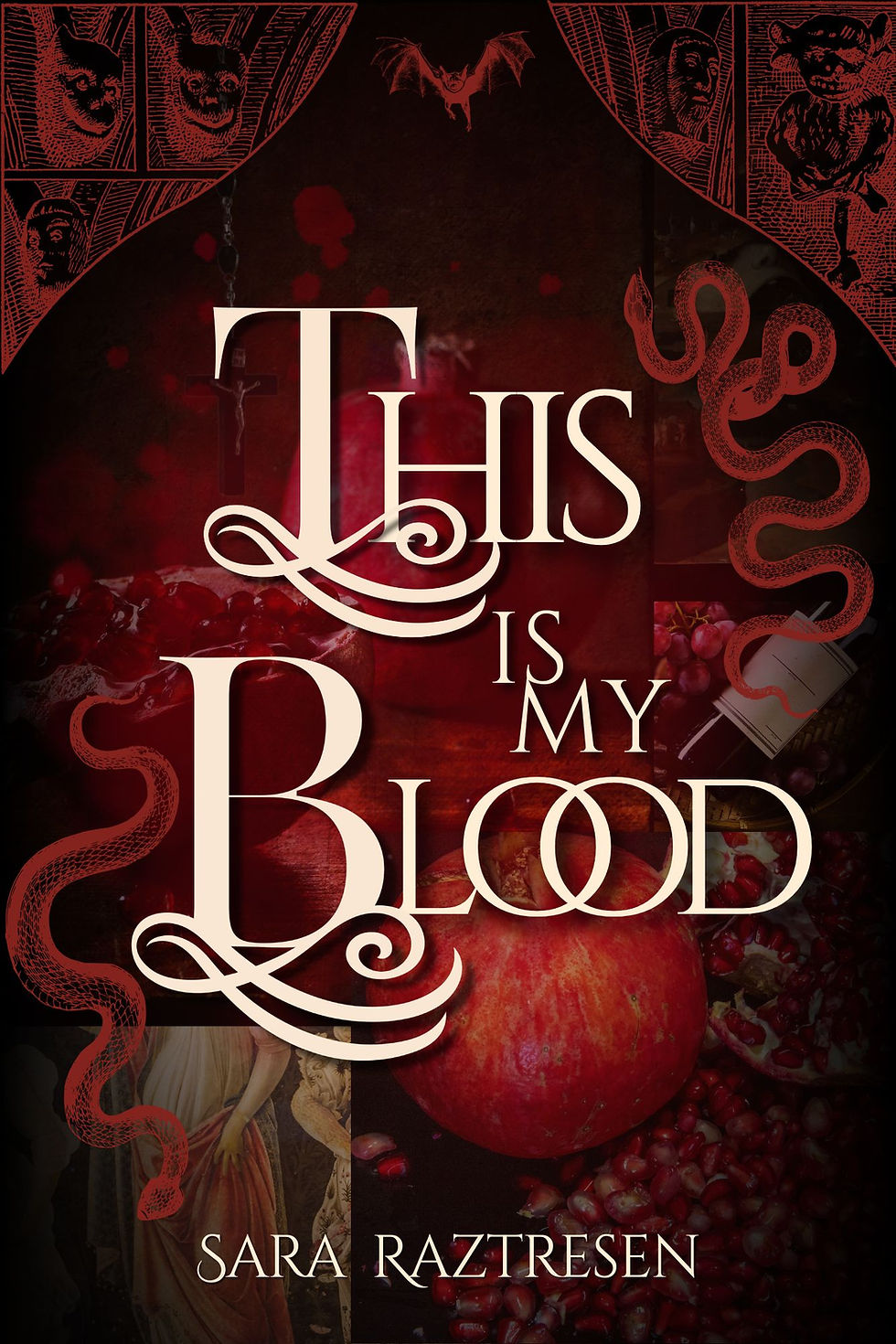
Because my latest book, This is My Blood, is now available for pre-order!
This book releases July 31st, 2026, and I gotta tell y'all:
I commissioned some beautiful art for this.
And it's making me want nothing more than to make this story the most beautiful thing it can be to match! I also plan to hand that art out to folks who order a paperback copy of the book, so... consider pre-ordering ♥
Anyway, here we are (finally) with May's questions. It's been a rough few months, especially with school, but now as I take this one month off before summer classes start, I'm able to sit down and sink deeper into all these more fun things to work on. And remember: you can always leave a question on my Google form, and I'll get to ten every month(ish)!
Let's get into all this good conversation!
What is Sin?
What is “sin”? This is something I’ve continuously been wrestling with on my deconstruction journey and sometimes it’s hard to not overthink it. —Summer
Hi, Summer!
There are many ways this word has been translated, and most ways revolve around some idea of missing the mark, as in, missing a target (like in archery): it's a mistake, it's an attempt made that didn't come out right, it's a misstep and a wrong action that needs to be corrected.
To put it very simply, sin is an act that goes against the Law (and Logos) of God. When you understand the Law to be hinged on love, and the Logos to be the knowing and full incarnation of love (as the Logos is Jesus Himself), this means that sin can't be boiled down to any set list of actions, but rather a root problem: the harm and disregard we do to ourselves and our neighbors, and therefore, directly or indirectly, to God.
When we get too focused on specific things that people call sins, we lose the forest for the trees. To focus on love, and letting your every action stem from love, is a great place to begin when it comes to dealing with and understanding sin, which is the negation and disregard of love.
What is the Immaculate Conception?
Hiya, Sara! So, I recently joined a server where someone said that they got confused as a kid by the immaculate conception. So, how would you explain that in a christian witchy way? Thank you and peace be with you!! —Adagio
Hi, Adagio!
So a lot of people get confused about the Immaculate Conception because they think it has to do with Jesus, but it's actually about Mary! This bit of dogma is the idea that Mary was born without original sin, making her the perfect vessel to carry God's Son and stitch Him into flesh. This idea of original sin is coming from the whole Garden of Eden situation, with the apple and the fall from grace and all that, and so it works to set Mary up as a direct parallel from Eve: one who was created sinless and brought the knowledge of good and evil (and therefore the capacity for sin) into the world, and one who would've been born already touched by that mess if not for God's intervention, who therefore is a redemption of the image of Eve. This is also why Mary is referred to as the "New Eve" sometimes: she's essentially the righting of the original wrong, and her Son is the possibility that can come from this.
Is there a witchy way to describe this in particular? I don't know. I think of it as something like alchemy, or the concept of cosmic balance: where there is one, there is its opposite. What Eve broke, Mary repaired, and therefore the image of the Mother has been brought back into equilibrium once more.
Can I Keep Witchcraft and Faith Separate?
I went through a phase about a year ago where I had a lot of doubt in God and started practicing secular witchcraft. I had a lot of success just using herb and crystal correspondences and energy work, but when I got back into Christianity and tried to combine the two (using psalms and Bible passages as incantations, using saint candles, prayers, etc.), I felt like my results weren’t as potent.
I feel very strongly about my faith now and I feel like my lapse was actually part of my spiritual journey to reinvigorate and renew my relationship with God. But I don’t want to let go of spell work, because it has helped me immensely in giving me a sense of control over my life. It seems that in any faith, especially pagan faiths, witchcraft and the religion go hand in hand, so I feel almost guilty separating them. So I guess my question is, is it possible, or even wise to keep the two separate, or can you give advice as to how better to incorporate the two? —Anonymous
Hey, there!
Honestly, I'm wondering why you would want to keep these separate. Sure, doing all this magic might've given you a concept of control over life, but control of that caliber is an illusion. Of course you can do great magic without God, just like a laptop can run for a while without being plugged in—but what happens when you stay disconnected from the Source of all that Is too long? What happens when your spiritual battery runs dry? And what if these "weaker" spells you're experiencing now are not just a way for God to test you or get you to trust Him, but also a sign that you should be slowing down or reconsidering the things you're asking for? Is the effect of your magic worth more than the abandoned wisdom it costs to get what you want?
What I'm seeing in a question like this is a misunderstanding of God and the purpose of magic. If all magic is to you is a way to make your life easier and prettier, then I guess it wouldn't be compatible with the essence and Logos of God to begin with. But if you understand magic as a gift and a tool to further connect with God and allow His presence to overwhelm and permeate your life, then this question is incomprehensible. God is known to work with less and less, to the point of seeming impossibility of the task materially, because He wants to show you that it is through Him that the greatest capacity for change and growth can happen. We see this in Judges, when God tells Gideon to get rid of the huge amount of soldiers he's prepared to attack the Midians (Judges 7:1-8):
7 Then Jerubbaal, also known as Gideon, got up early along with all of his soldiers. They encamped near the Harod Spring. The Midian encampment lay in the valley to their north, near the hill of Moreh. 2 The Lord told Gideon, “You have too many soldiers with you for me to drop Midian into their hands, because Israel would become arrogant and say, ‘It was my own abilities that delivered me.’ 3 That’s why you’re to ask in full view of the soldiers, “Whoever is afraid or is trembling may go back from Mount Gilead and return home.” So 22,000 soldiers left and 10,000 remained.
4 “There are still too many soldiers,” the Lord told Gideon. “Bring them down to the water and I’ll refine them for you there. Therefore when I say to you, ‘This one will be going with you,’ he’ll go with you, but no one may go about whom I tell you, ‘This one won’t be going with you.’”
5 So he brought his soldiers down to the water, and the Lord told Gideon, “You are to cull out everyone who laps up water with his tongue like a dog from everyone who kneels to drink.” 6 The contingent of soldiers who lapped water with their hands to their mouths numbered 300 men, but everyone else kneeled to drink water.
7 Then the Lord told Gideon, “I’m going to deliver you with the 300 soldiers who lapped by giving the Midianites into your control. Send everyone else back to their own homes.”
8 So the soldiers took provisions with them, along with their trumpets, and Gideon sent all the rest of the soldiers of Israel back to their own tents, but he retained the 300 men. And the Midian encampment was below him in the valley.
Logically, they probably should've had more soldiers if they were to go up against this enemy. God Himself recognizes this: He sees how, had they more manpower, they would think it was their reason that the Midians fell. God purposely reduces the power of Man, therefore, so that He can show that Man's efforts don't dictate what God has decided. Perhaps the weakening of your own spell results is the same: for God to show you that while your own power is all well and good, that you're missing the opportunity for larger connection and growth and wisdom by only looking for these petty material concerns.
How Can Anyone Distinguish Between Prayer and Witchcraft?
If all power ultimately comes from God, then how can anyone truly distinguish between prayer and witchcraft without relying on human authority to define what is acceptable? When structured practices like invoking divine names, repeating specific prayers, or using ritual objects begin to produce real spiritual experiences, at what point does devotion become indistinguishable from ritual magic? If someone genuinely feels closer to God through practices condemned as witchcraft, does that reveal a flaw in their approach or expose a limitation in how religion defines and controls access to the divine? —Anonymous
Hello!
Boy, aren't these some good questions? These are the questions I wish people would be asking themselves more often.
People will try to give you all kinds of semantic answers to these questions to justify their own positions. They'll say that the "Devil" makes "false power" somehow—as if light from the sun and light from a lamp don't accomplish the same goal, or as if the sun wasn't the great thing that gave the lamp the potential to be created and exist eons and eons after the first sprout rose from the first lush soil. They'll tell you that they aren't doing anything when they pray or ask God for help, but to do witchcraft is to show a lack of faith all because you dared to pitch your hat into the ring with God in His creative work.
But the thing is, we are meant to co-create with God. He invites us into this experience, implores us to make the beauty of the world with Him, and that is what people miss when they try to put God in a glass box and never cross paths with Him in this way.
Let's also have some grace for a minute. Religious institutions aren't always basing their restrictions in the need to control a populace, too; sometimes they're trying to prevent calamity, as we've no doubt seen many people go off the spiritual deep end when they have this idea that there are "no rules" in magic and spirituality. Sometimes institutions try to steer the whole general populace in a "safe" direction that prevents people from losing their minds, as is so often the case in occult philosophy and science (because after all—the trope of wisdom leading to divine madness exists for a reason). But in these institutions efforts to protect (and control), they have in fact also proven their limitations how close they can get to the God they claim to serve, thus cutting themselves (and others in the institution) off from the possibility of more.
Magic is miracle is medicine. Ritual is witchcraft is ceremony. Our need to splice one off from another is rooted in semantics, politics, and the age-old "us vs. them" mentality.
How Can I Get Closer to God Through Witchcraft?
Haii Sara! I wanted to ask how can I get closer to God by using witchcraft? I know it’s my path but I wanted to know your experience because I have no idea how it works. —Laurent
Hey, Laurent!
So, as I was saying to our friend earlier who wanted to separate these things: the thing about magic is that it becomes less of a tool to get things you want (like money, love, friends, etc.) and more a craft, a creative process, a never-ending self study. It is an artistic endeavor, as well as a scientific one: it requires us to imagine, then question, then test, then observe.
In my experience, I've grown closest to God through witchcraft when I put my own wishes and desires aside and let God be the conductor of the power He's entrusted me with. My magic these days is less about casting spells and more about having conversations: I meditate with angels and demons, I look to God for direction on where and when I'm supposed to move, and I learn the discipline required to stay my hand even when I really want to act, if God says it's not the time to act. (And vice versa: if I want to avoid something and God tells me to jump in the middle of it, I do that too.)
Magic is the manifestation of the "breath of life" that God has breathed into us all. It is our energy, life force. Like any muscle, it needs to be exercised for us to gain more control over how it escapes and twists into the world, but when that exercise is done with God (through ritual, contemplation, studying, reading, conversation with God, etc.), we start to discover where our will and God's will blur together, and that's where you get really close with God—close enough to become His hands and feet on earth.
Who is the "Devil" or "Dragon" in the New Testament?
If Satan and Lucifer are just titles, and the idea of the devil being a rebellious angel didn’t come till much later, then who is the devil in the New Testament? Who is the prince of the world and the adversary? Who is the dragon? I hope this makes sense. —Anonymous
Hi!
So, I actually have encountered this being known as the "Dragon." I've written about it on Patreon (and this post is free to read for all), so that might give you some more insight, but in essence, this is a concept that occult philosophers have extrapolated on. In essence, when God formed not only the world, but Himself from nothing, He had to define everything into strict boundaries. A rock could no longer be a vine, which could no longer be a fish, which could no longer be a bird. These things that all existed simultaneously in one never-ending and never-starting pool of Being were suddenly given shape and form and distinction—and God had to therefore give Himself the same, before He could do it to the rest of the world.
When God did this, however, He also had to define what He is not—which, given He is All, and infinite, was pretty hard to do, but it did get done. We don't think of God as evil or malicious or any of these things, after all; there were qualities of un-creation that couldn't be attached to Him as a result. Really, therefore, what this thing is, is chaos: the leftover undefined matter, the part of God that He cast off so that He might exist separate from all other things that stemmed forth from His division and categorization of creation.
This thing exists, though. It was born when God named it and put it out of Himself. It is God—but the piece of God that is incompatible with creation, the chaos, the formless abyss, and it wants to be whole again. It wants the greater part of itself back, and it is trying to bring about the end of the world, where God lets all of creation fall back into primordial soup, so it and God can be one again, and all creation can return to the formless deep from which it all came from. The closest it came to winning, maybe, was the Flood, when nearly everything except Noah and his family and the pairs of animals died.
Which means the death of us all, and the dissolution of all that was, is, and will be. And obviously, we don't want that. We want the Garden to extend further and further, a world without end. So we push back on the Dragon's efforts to push God into annihilation.
What Books Should We Read in Christian Witchcraft?
I’ve heard you press the importance of scholarship when it comes to Christian witchcraft, so what books would you recommend starting out as someone who is willing to jump in the deep end? —Samuel
Hello, Samuel!
This is actually a great time to pop out this book list I made on Fable: it's got some of my favorite scholarly books on there, and I add more all the time. Check that out for my collection of Christian Witch related books!
However, aside from Discovering / Discerning Christian Witchcraft, I will give a general bit of advice for looking for new books: choose authors with proper academic credentials in theology, history, archaelogy, and anthropology.
If an author's education comes from some bum "academy" nobody's ever heard of, chances are they might be more into BS apologetics than actual information. It's also helpful to get works by folks who don't believe in religion at all, too, because they don't have the theological impulse to try and explain away contradictions or issues (Francesca Stavrakopolou comes to mind: she loves religion and stories and myths, but is an atheist, so her work, God: An Anatomy is very direct and to the point with the facts we know, not the ideas she wants to believe.)
At the same time, though, folks who do believe, and especially believe in the inherent dignity of humanity, like the mystics (Meister Eckhart) and the philosophers (Hans Ur von Balthasar) and theologians (Dietrich Bonhoeffer) will have some really interesting ideas to share that do deal with the realm of belief and contact with God, and those are priceless, too.
How Does God Feel About Bigots?
How does God feel about bigots? What about abusers? —Anonymous
Hi!
God feels about them the same way He feels about everyone: great love for the human souls He's created, and great grief at their error and the harm they do to themselves and others.
That's all there is to it.
How Do We Defend Universal Salvation?
Hi Sara, have you ever had to defend your beliefs on universal salvation? And if so how did you go about it? —Michael
Hey!
Honestly, I don't really feel the need to defend my beliefs to anybody, so as for that first question: on a technicality, no. I believe what I believe.
But why I believe it, I can explain. It was especially reading the works of Saints like St. Catherine of Genoa and St. Julian of Norwich that gave me the idea that God doesn't condemn anybody to any kind of eternal burning hellfire, as well as the fact that the ideas of hell we do have are largely extrapolated bits of fanfiction like Dante's Inferno. The reality of the situation is that God is infinite in His grace, mercy, and love, and therefore does whatever He can to bring us back to Him, even if it's in those last moments. St. Catherine defines purgatory as a mercy, in that even if it's hard, painful, and difficult, it still gives us the opportunity to cleanse ourselves so we are, in our own minds, worthy to stand before God.
That's the big thing there: it isn't God that denies us union with Him. It's ourselves. Because we see the glorious perfection of God, and we see our own pitiful lack, and we can't bring ourselves to join to Him when in such a state of battery and disrepair. God gives us purgatory—the lake of fire, in which we have our baptism of fire—to cleanse us, restore us, and bring us to the final perfection that we can accept seeing unified to His magnificence.
Where is the room, then, for eternal punishment? Maybe in a soul so broken, so damaged, so utterly contemptuous of God and its own existence, that it would refuse even purgatory. But these souls don't burn forever, either. They simply disappear into the abyss, out of existence. (And given my earlier explanation of the Dragon... one is left to wonder if even after we all join with God, that we wouldn't all be brought to this abyss of non-existence one day anyway.)
Jesus has defeated sin and death. What, then, is the reason to believe any amount of sin or death on earth would ever stop us from being redeemed in any way? It's just a silly idea.
Is Wearing Makeup a Sin?
Is wearing makeup a sin? I’ve been getting into the book of Enoch because of the early church fathers quoting it, and the book of Enoch says that the fallen angels showed women makeup and jewelry. Some Christian women online use this as proof that makeup is demonic, but weirdly never mention that the angels taught men to make swords and knives (which is used all throughout the Bible,and also by their weird literalist logic,means owning cooking knives is a sin). Jewelry too in canon scripture has both positive and negative connotations. I want to know your thoughts on this-is it the things themselves that are evil, or how they were used? —Anonymous
Hi, there!
This is a funny question, because you're right! The other watchers did teach us to make metal instruments like utensils and swords—and in fact, it's those tools that got the other angels and God to finally take notice, because those tools were the ones used to bring all this death and despair to earth and cause people to cry out to heaven for help to begin with.
And yet we still use silverware, and swords, and cars, and anything else that requires metal. In fact, we've made weapons worse than even the angels taught us how to make. Now we have tanks, planes, bombs, cannons, drones, and so much more. Swords aren't even useful anymore in this world of modern warfare.
Christian women using the story of the Watchers to decide that anything is inherently demonic are, in fact, super silly. There is nothing about the tools themselves that are the problem (and that includes root work or magic, makeup, or metallurgy). The reason we weren't meant to have these things is comparable to the reason why, in Greek myth, we weren't supposed to have fire: because it helps us evolve to a point of creation and destruction that could very well upset the entire balance of the cosmos. However, nobody faults Prometheus for giving us fire, nor can we say that fire hasn't been one of the most important technologies humans have ever learned how to master and contain. Without it, we literally wouldn't have evolved; we wouldn't have learned to cook, and therefore eat cooked foods, which is the direct reason we grew the brains we now have and were able to one day stand upright on two feet.
The Watchers are like Prometheus in that way: they gave us the secrets of heaven, and now that those secrets are here, we have to use them carefully for our growth and evolution, not for our own destruction. We do really like to destroy ourselves, though, so it's still been a struggle to use these gifts for good without also using them for evil.
Ask Your Questions!
Remember, all your questions can go to this Google form, so don't hesitate to reach out! I'm looking forward to seeing what questions people have in the future, and I hope this has been a helpful read! Thank you everyone who participated!
—Sara

Sara Raztresen is a Slovene-American writer, screenwriter, and Christian witch. Her fantasy works draw heavily on the wisdom she gathers from her own personal and spiritual experience, and her spiritual practice borrows much of the whimsy and wonder that modern society has relegated to fairy-and-folktale. Her goal is to help people regain their spiritual footing and discover God through a new (yet old) lens of mysticism.
Comments