


Ask a Christian Witch: Reconnecting with God, Confessing Our Sins, and Resources for Learning

It's Q&A time again already!

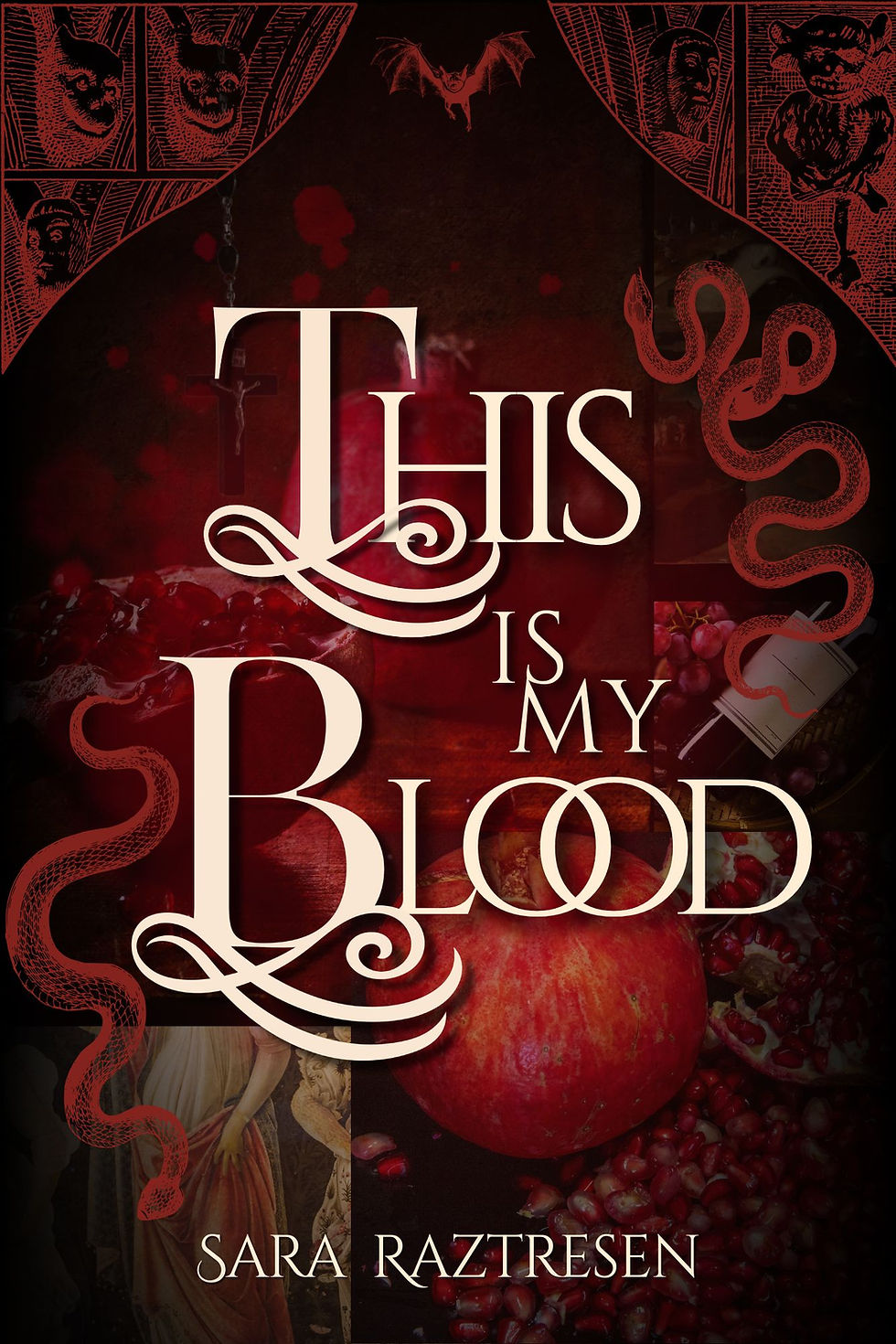
Because my latest book, This is My Blood, is now available for pre-order!
This book releases July 31st, 2026. Here's a little summary for y'all:
A money spell, a life overhaul spell, and a love spell, all in the same week?
Piece of cake for an occultist like Nadia Wojcik. For the thirty-two year old Polish-American, life's been feeling like a shirt shrunk two sizes too small in the wash, and she figures it's about time to ask the Man upstairs to shake it up a little. Maybe she'll get a promotion. Or maybe she'll leave her cozy little state of Rhode Island and start an adventure across the country. Hell, she might even find a partner that doesn't scoff at her grimoires and occult texts (or LARP as a Crusader and call her a heretic for it).
But when her spells spin out into the world, unbeknownst to her, she ensnares a real three-for-one deal (at the cost of one of her main magical gifts): a certain Elias Belevonis, owner of a local winery in Rhode Island's northern farmlands, who has a beautiful house, plenty of connections in the city, and just as odd interests as Nadia.
The only problem is that he comes with fangs—and several lifetimes' worth of baggage.
Anyway, with all that said, boy. Getting through the end of the semester was a rollercoaster, and that's why we're looking at April's questions in the first week of May—but better late than never, right? Remember: you can always leave a question on my Google form, and I'll get to ten every month(ish)!
Let's get into all this good conversation!
How Does Confession Fit into Christian Witchcraft?
How might confession and absolution factor into Christian and particularly Catholic-based witchery? I know there’s also general confession, but I’m particularly interested in personal confession especially since some clergy may see what we’re doing as something needing confessing rather than as mysticism. —Anonymous
Hi, there!
When it comes to confession, the first thing to understand is that confession is for the purpose of bringing active sin into the light rather than letting it fester. The point of confession is to not only bring the sins before God for absolution, but to bring yourself to recognize them and acknowledge them as the sins that they are.
Everybody sins. Everybody does things that are hurtful, whether to themselves or others, that require us to step back and think about more critically. Nobody wants to do this because it hurts our self image and our pride to admit that we were wrong, and it is psychologically painful to accept that we have done harm even when we didn't intend to or when we didn't think we did. But by doing this, it helps us stop hiding, making excuses, or justifying harmful behavior and therefore come back into alignment with God and His Spirit of love, mercy, and community.
For that reason, confession is a good thing. Having a person to confess to is important because speaking it out loud makes it impossible to turn away from, but given priests are bound to confidentiality, there is absolutely nobody else on earth who will hear that confession except that priest unless you choose to confess to others. Maybe the priest can give you some council or help you figure out what to do to make amends, but the primary purpose is to speak it out, be blessed, and be given some way of spiritual reparation/repentance (like doing X amount of prayers, etc.).
Thing is, though, you really only need to confess/repent to God (especially if the thing in question wasn't something you need to go seek an apology for or make right with others, like if you fed into the sin of gluttony and just ate or indulged in some comfort to mentally/physically damaging excess; in that example, nobody else got hurt there but you). And more than that, what the priest themselves thinks are sins are not automatically sins. It doesn't really matter what some clergy have to say when there are other clergy who have the total opposite opinion; if you have the understanding, the knowledge, the scholarship, and the guidance to know what you're doing isn't a sin, then the clergy's opinions are irrelevant at best, actively incorrect at worst. That isn't a thing to even think about in this regard; it wouldn't be confessed in the first place because it's not an issue.
What is "Source"?
Hi Sara, I already asked a question but I had another. I've been reading your books and finished your interview with the Holy Spirit and she mentioned something called the Source. I'm a little confused and I've been looking though some of your videos and other book to try and figure out what exactly that is. Is this Source God or is it heaven? The general divine? The universe? —Anonymous
Hi!
So, I think one thing that confuses a lot of people is not just who God is, but what God is. People often conceptualize God as this Man in the Sky™ archtype; they think He is literally some Zeus-looking old man with lightning bolts and all that. God is the Source of all creation; it's from Him that all things that exist have flowed forth. God is the singularity from which all things exploded into being and beget the things that came after it: the atoms to the molecules to the compounds and rocks and water to the microbe to the fish to the land animal to the life we see around us today. Understanding God as the infinity of Being and the central origin of love and life itself helps us grasp at least a tiny bit of the gravity of this being we call God. That's what the Holy Spirit was talking about there.
What Does the Bible Think of Astrology?
I’m really curious on what the bible thinks of astrology! I know there’s a passage in Leviticus I think? Unsure as of now! I don’t use it to try and read the future but kinda as a guide from archangels/Holy Spirit, but I just want to be sure I'm not missing something important!—Anonymous
Hey, there!
So, wherever we have astrology mentioned specifically in the Bible, you'll notice a lot of the major ones coming from Isaiah, Daniel, etc. have to do specifically with Babylon and the Babylonian king Nebuchadnezzar. For example:
Daniel answered the king and said, “No wise men, enchanters, magicians, or astrologers can show to the king the mystery that the king has asked, but there is a God in heaven who reveals mysteries, and he has made known to King Nebuchadnezzar what will be in the latter days. Your dream and the visions of your head as you lay in bed are these... —Daniel 2:27-28
You are wearied with your many counsels; let them stand forth and save you, those who divide the heavens, who gaze at the stars, who at the new moons make known what shall come upon you. Behold, they are like stubble; the fire consumes them; they cannot deliver themselves from the power of the flame. No coal for warming oneself is this, no fire to sit before! —Isaiah 47:13-14
What's important about these things and Babylon, though, is that Babylon (and the Zoroastrian magi that were the priests of the region) had a very fatalistic understanding of astrology. They were convinced that whatever the stars in the sky said was final, and that nothing could be changed, that they could accurately chart and predict the future by looking up at the sky and that they had everything figured out. If you were born under the sign of the Ram (Aries), for instance, that was it: you were doomed to be war-like and aggressive.
Jewish (and later Christian) people did not believe this. They believed, and still believe, that God has the ultimate authority—that even if the stars stay their course, that God can change these things at any time, and so it would be ridiculous to think you could guess everything God is planning or understand the mind and action of God based on the celestial bodies. It was also an insult to the free will God gave us by assuming nothing we do and no choices we make mean anything; when we look at astrology this way, we release our agency and let ourselves become slaves to the current of "fate" without realizing that we make fate.
There is a lot of theory about angels, and belief that there is a class of angels (I think Dominions? don't quote me there) that move the celestial bodies per God's design, but as because of God giving us free will, and for Christians, especially because of Christ's sacrifice, we are basically freed from the constraints of natural law; we can chart, acknowledge, and feel the influence of celestial bodies like Jupiter or Mars, but we aren't constrained to it or bound by it. Understanding that can help us make the decision: do we want to lean into a certain energy going around (like with this Uranus in Gemini transit everyone's talking about), or do we want to brace ourselves and stay afloat in the storm even as others get swept around (like when it was in Taurus)? Even if Uranus's shifts signal the truth of the cycles of disruption, the fact is that how we deal with that disruption and how we choose to let it affect us are our choices, not the choice of Uranus.
And remember: nothing in nature is set in stone until God decides it is, because God made the stars.
Reconnecting with Jesus as a Jamaican Practitioner?
Hi, it’s nice to meet you! So far with the context of Jamaica: I grew up in Jamaica, and if you didn’t know, Jamaica was colonized by Europeans (the Spanish and English) where are they then brought Christianity the Roman Catholic and the Anglican denomination, respectively... I’m not sure if it’s possible is it possible and also I know that I may be intruding in your practice or asking you to intrude in your practice to ask this of you and you don’t need to, but could you maybe mention me in just an off prayer or interaction with God or Jesus and let them know that I’d like to work with them as well or get to know them? Those are the only two questions I can think about right now thank you for your time. —Anonymous
Hi, there!
Of course I can ask that for you! God, Jesus, and the Holy Spirit are anywhere, everywhere, and there for those who seek Them out.
In terms of the rest of your story: because of the nature of colonization, where religion is less a genuine means of spirituality/connection and more a tool of the colonizers to demand obedience/replace and squash other cultures to establish their own on top, it is possible that the idea of Jesus people come to have may be pretty dented. Examples are seeing Jesus as white or the race of the colonizer even when the people being forced to accept Him are not, or a theology that focuses on strict obedience to a preacher or the Church over independent religious study and allowance for cultural connection/expression within the religion.
The easiest way to get away from this is to go to the places you feel are divine, be they nature, memorable places or nostalgic ones, etc., and let the presence of the Divine (God/Jesus/Holy Spirit) approach you the way you'd let an old friend approach you. No expectations, no scrutinizing your behavior, just talking openly and honestly without fear. If you feel uncomfortable, scared, or small and ashamed, that likely isn't Real Jesus. If you feel a comfortable quiet, and a sense of love and mercy, though, that's more like it.
Best of luck in your walk forward! ♥
Can You Still Be Saved Even When Working with Other Gods?
I’m wondering… if a person chooses to focus on a particular pantheon (let’s say chooses to worship/work with a slavic god) but still acknowledges Jesus and God (the big G) as the Highest Power—can they actually reach the salvation Jesus speaks of through that worship? Or is giving yourself in the spiritual practice to Jesus and God only required? Or can we explore Divinity with more engagement like leader worship? Where is the boundary? I know some of us have trouble feeling connected to the Abrahamic God, don’t vibe with working with angels and I’m not sure if it’s because of readiness of the soul (needs less intimidating Divine experience at this point of development) or is it simply just how some were created in the first place and that is all the human shell can deal with in this lifetime? By the way, this question came to me from the interview You did with Weles, Zorza and Łada (Polish spelling :) )—Anonymous
Hey!
Yep! Especially with non-Jewish folks (Gentiles, AKA anyone not Jewish), God never expected people to give up their gods, only to acknowledge God as the God above all (the Source, the God of gods, however we imagine that). There are many dual faith practices, as well, that hide gods under the names of Saints or otherwise include these gods as folk heroes or other characters side by side with God and Jesus and Mary and everyone else; it seems more like this is a community of Divinity, or that these gods can function like angels (as angels themselves bear an aspect of God in their name and seem to serve the purpose of helping us focus on a single quality of the Divine vs. trying to perceive His infinity or any one idea of Him).
Is Praying to Mary Idolatry?
I made a covert prayer bead necklace inspired by Elizabeth Harlander from the new Frankenstein movie. I pray with it like a rosary or a prayer rope, and I’m glad I made it but something has been on my mind: are the “prayers” asking Mary to pray for us in the rosary idolatry? —Anonymous
Hi!
So, short answer, no. This is a hyper-Protestant take, and that'll also address your later question about why the Episcopal Book of Common Prayer (BCP) says it's bad: because Episcopalians are Protestants, even if they act like Diet Catholics.
A large part of Protestant theology (more in certain denominations than others), ironically, ignores the entire point of the Gospel: the defeat of death. They insist that because people are dead, that they can't hear the prayers of the living, completely ignoring the idea of the living communion of Saints in Heaven and on Earth. A lot of folks think that praying to them is therefore useless at best, idolatry and necromancy at worst. This is not true. Revelation as a book repeatedly mentions Saints who are active in Heaven now, watching over Earth and praying in the afterlife, for example.
Moreover, the entire concept of idolatry is way more than just "acknowledging other entities exist." This was a very specific practice in the Old Testament world that we've discussed a few times, but in short, it was a ritual in which people would guide their gods down to Earth to literally live in a stone or wooden icon; they would then treat the wood/stone as if it were the god itself, because as far as they were concerned, that was exactly what it was. Obviously, this kind of vehicle is therefore super easy to control and to forget is just a representation of the god, not the god itself with any actual power inherent in the stone. God wanted people to not do that so that they would not only not try to constrain Him to any one shape or form or place, but also to remind His people that He has no form they can readily conceive of and that they shouldn't trick themselves into thinking that the faces they carve to represent Him are actually Him.
So no, praying to Mary for intercession isn't idolatry. It's not even in the realm of the original contextual definition. Moreover, Catholics will classically tell you that you're asking Mary to pray for you, not actively talking to her (which, as a Christian Witch, I find stupid; call a rose a rose and admit you're talking to the very living, very active Heavenly Mother). But if for nothing else, you can think of it this way: if you wouldn't consider it idolatry to ask your actual mom or your friends or your congregation to pray for you, it makes no sense to consider it idolatry to ask Mary to pray for you.
What Denomination Should I Be to Work With Saints?
Hello! I grew up as a non-denominational Protestant with evangelical and moderately fundie leanings. Since now I feel being a Christian witch is the right path for me, I also feel called to work with the Saints (along with God and the angels of course) for my spiritual practice. My question is do I have to be Catholic, Angelican or Episcioalian to work with the Saints? —Anonymous
Hello!
Here's the thing: you don't have to be any specific denomination to pray to a Saint. Most of them were Catholic and may have some type of feeling about someone being part of a schism (Protestant, etc.) but there are plenty of Protestant Saints, too. They're all part of the Church: the one universal body of believers. They're open to all!
(Also: Anglican and Episcopal are the same church! Episcopal refers to the Anglican church in America specifically. ^-^)
Free Materials for Studying Christian Witchcraft?
Hello! if it's not much of a bother, do you have any cheap/free material recommendations that could help me be more educated in christianity/witchcraft/christian witchcraft as a beginner? I'm from a third world country so I'm lowkey having a hard time looking for accessible and reliable sources. —Anonymous
Hi!
I got'cha! There are tons of free YouTube channels and podcasts that are really helpful, such as:
Esoterica (occult studies)
Dan McClellan (Biblical studies)
Religion for Breakfast (religious studies)
You can also find free tarot resources through Biddy Tarot, which has free explanations of all the cards for free, and sites like Daily Tarot Draw can help you do tarot with just your phone/computer. With witchcraft especially, honestly, I'd recommend peeling through your local folklore and seeing what kinds of morals you can learn, what figures show up often, and what kinds of plants or art surround them; that might help you figure out more about folk magic in your area, too! But all of these are a great place to start in the meantime!
How Do I Reconnect With the True God?
Hi!! so recently with everything that's been going on with toxic Christianity as well as the (valid) resentment and trauma that non-believers have with the religion, I've been feeling myself kind of slip away from my faith in god as i subconsciously correlate the deeds of those Christians to him mixed with this hateful image those non-believers have of him, causing me to have this bitterness too. i know deep down that this is not truly the god that i love, but i'm having a hard time clearly picturing and truly connecting with the true god when in the back of my mind, that image continues to stay. what can i do to educate myself and be more connected with god without the media tainting my image of him? thank you so much!! —Anonymous
Hey!
So, honestly, the one thing that has anchored me no matter what went on in the world when it came to identifying and pursuing God was asking this:
Does this [belief, tradition, etc.] cause harm to innocent people, or does it operate in the healing power of love?
If it harms people (for example, purity culture, homophobia, etc.), then it's not of God. If it operates in love (mercy, forgiveness, kinship, compassion, etc. for others unconditionally) then it is of God. I've also always been bold enough to look God straight in the face and ask when things didn't make sense to me: I'd ask why witchcraft was so bad if it was being used for good things and good reasons. The true God will happily and patiently explain things to you. A false pretender will get angry, impatient, sullen, and try to shame you out of having any questions to begin with.
Go out in the wildnerness, too. Go out in nature, away from people, and recognize that God is both within and around all the things He's made. The grass won't tell you lies about Him, and neither will the rocks or the waters or the birds. Listen to them if you really want to know the true God vs. the false god of the media!
How Do You Reconcile Christianity and Witchcraft?
Howdy saw your profile and thought it was interesting that you are a Christian witch, how do you reconcile Christian theology and witchy stuff? Into tarot and reiki but a Christian as well. But people have always said that tarot and reiki is demonic and relying on other gods. —Anonymous
Hi, there!
A great question! It's one we've answered many times before; I think this blog here will be your best bet in getting that question on Christianity and witchcraft answered, whereas this blog on whether Christians can use tarot will handle that topic. Moreover, it's interesting you mention people say that reiki is "relying on other gods," because what I know of reiki is that it doesn't require any gods in the first place. I could be wrong about that, though.
In short: what we call witchcraft today is the vehicle in which religion, including Christianity, is operated. You can't access mystery without mysticism. It really is that easy.
Ask Your Questions!
Remember, all your questions can go to this Google form, so don't hesitate to reach out! I'm looking forward to seeing what questions people have in the future, and I hope this has been a helpful read! Thank you everyone who participated!
—Sara

Sara Raztresen is a Slovene-American writer, screenwriter, and Christian witch. Her fantasy works draw heavily on the wisdom she gathers from her own personal and spiritual experience, and her spiritual practice borrows much of the whimsy and wonder that modern society has relegated to fairy-and-folktale. Her goal is to help people regain their spiritual footing and discover God through a new (yet old) lens of mysticism.
Comments