


Ask a Christian Witch: Breaking Generational Curses, Contributing to the Great Work, and God's Wrath

It's Q&A time again already!

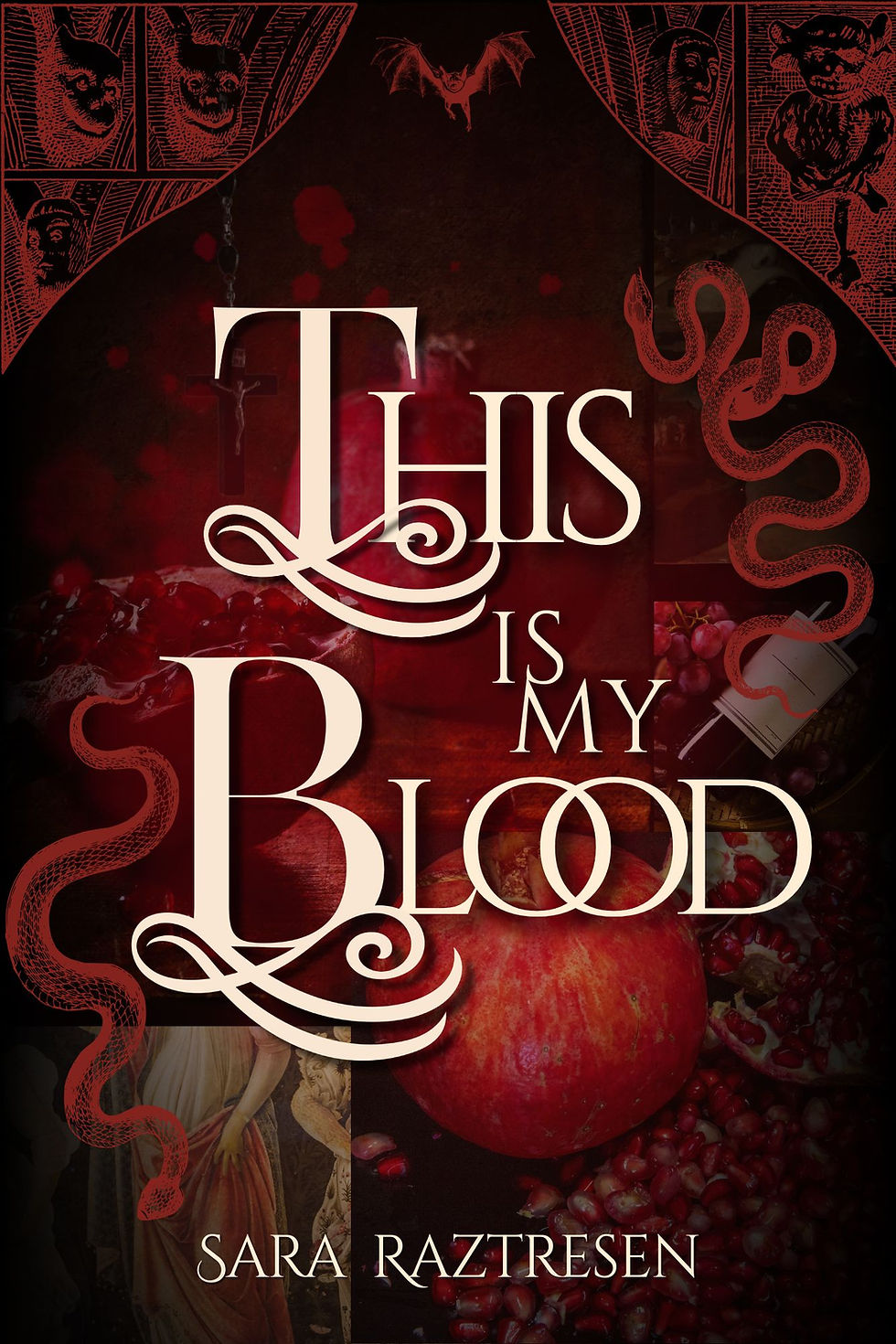
Because my latest book, This is My Blood, is now available for pre-order!
This book releases July 31st, 2026, and I got my proof copy!!! We're going to read it on the way to and from my little trip I'm taking, then get the design perfectly settled, and that'll be it, it'll be done! Finally!
Anyway, here we are with June's questions (technically on July). I'm looking forward to a quieter July, maybe, as I begin really tunneling on my next work, which I'll tell y'all more about as we go along.
And remember, if you have questions, there's a Google form!
Now let's get into all this good conversation!
How Do I Break a Generational Curse?
Hello Sara. I was talking with my mother the other day and she suspects that we probably have a Generational Curse (Curse of Poverty most likely). I wanted to ask if there is something we can do or if we HAVE TO pray, hope and wait that God breaks that curse for us? (That was the most frequent answer I got when searching for Generational Curse breaking.) —Anonymous
Hi, there!
Honestly, with generational curses, I think the thing that makes them so difficult is that they become ingrained in terms of patterns of behavior, frames of mind, choices made, etc. You might ask God and pray to God for help, of course—but God's going to want you to do just as much effort. Our works with God are cooperative, not one-sided. You have to dig deep, find theb root of the issue, and address it, which can mean doing ancestor work to find the one who kicked all this off, or shadow work to find out where its roots have dug down into you.
You also have to understand that with things like poverty... it may not be a generational curse. It may simply be a matter of systemic failures living in a society that doesn't value communal support or flourishing. Not everything is the product of some karmic debt or some evil spiritual means; sometimes the evil is coming from those in Washington, or your local state legislature, who are abusing your community's resources and leaving you all without the means to lift yourself out of hard times. This isn't something you should blame yourselves for, and it's something that'll take a lot more than ritual to fix—like political activism and grassroots movements to support causes that will uplift the people.
That's a harder issue to tackle than the idea of a generational curse, though. Much harder. And it can't be tackled alone. Your community needs to want it to end enough to organize and end it.
(NFSW 18+) What to Do About Being Guilted for Self Pleasure?
What to do when other Christians make you feel guilty for self-pleasuring and having fantasies with fictional characters? (Sorry if that’s too inappropriate) And what is actual biblical lust not defined by fundie/evangelical culture? —Anonymous
Hi!
Now here's an interesting question! If we start with the idea of lust, then very simply, lust is something that causes transgression against your neighbor. In biblical times, though, you do need to remember that women were seen as property (both within Israelite society and many other societies; it's just how things were thousands of years ago and how things still are in many places far removed from that part of the globe). Misogyny and the patriarchy have existed for millenia, and only now are they starting to ease off.
So things like infidelity, in which lust might've been involved, were actually not about lust. They were about theft of property and property damage. Which is why women would be stoned ("worthless goods") and why men were ordered to pay money to the father in the case of an assault and forced to marry their victim. It's ugly business, and it's never been right, but like things like slavery, God's been trying to lead people away from these things slowly, over time, so as not to give people whiplash and abandon Him for rules that go against what they know too much. As it is, God already has a lot to say about how hard-hearted and hard-headed the Israelites are when they don't listen to Him in the Bible; push too hard, and it's all over.
Lust as others have come to define it in later eras, however, and especially modern ones, is anything that reduces the dignity of a human to what you can gain from their bodies. If you're looking at someone like they're a cut of meat, and you don't care anything about their mind, personality, soul, wellbeing, etc.—and especially if you don't care about their consent, or their health, or their wishes, or their comfort—then that's a serious crime, because you're not seeing the other human as a human, in the image of God. You're seeing them as basically just a piece of meat, or a toy, for your own pleasure. That's not right. True lust (sinful edition) is insanely dehumanizing and makes other people feel dirty and violated.
A healthy lust (like between partners, or even just between chance encounters with people who magnetize you for reasons beyond just the physical, where you appreciate more about them than just their body) is intimate, interesting, and beautiful. (But it can be hard to walk away after that, which is why this whole idea of waiting for marriage (or at least a committed relationship of some kind) in a modern lens is really important: that's a vulnerable position to be in, and it can really mess with your head if you share that with someone and then never see them again. That can cause a lot of heartache and regret and listlessness in the case of those one-night-stand type moments.
When it comes to the self, though... it's yourself. There's no other person involved. And fictional characters? I mean, whatever. They don't... exist. You might learn more about yourself and the things you like, which may help you scope out better long term, permanent partners in the long run, but self pleasure is a regular part of maintaining one's energy, too. I see it as no different than taking a really cozy, spa-like bath, or eating your favorite meal that you've gone all out to make and really enjoy, or doing other such more indulgent and pleasurable aspects of self care. There's no shame to be had around it, and that energy goes stupid real fast depending on where you are in your hormone cycles and the like, too.
There's no shame to be had in it. Don't let people make you feel weird or bad for it.
How Do You Know Your Conversations with Spirits are Real?
I recently came by your work and I have really enjoyed watching your YouTube videos and reading your books as I am currently on the journey of defining what Christianity looks like for me and Christian Witchcraft seems to resonate. I'm in the middle of reading Where the Gods Left Off (my favorite interview is the one with Jesus) but one question still remains at the back of my mind. How do we know you aren't making all of this up? I mean after all, you are a fantasy writer and with a bit of research it would be very easy for you to come up with a captivating fantasy story. Some of it just sounds like reading a made up story. So how do we know it's real? —Anonymous
Hey, there!
This is a question I ask myself all the time, actually: how do I know any of this is real? Or that I'm not just getting very good at fantasizing and making a bunch of stuff up in my head?
That's actually why these books started as individual interviews, with videos to go along with them. I have the playlist on TikTok called Interview with the Gods, and in that playlist, I show everything I did to contact these spirits: the table set-up, the offerings, etc. Then I show the cards I pulled for every single question I asked, or the times that I got no sign to pull cards and got a loud, direct answer.
What lets me know that what I'm experiencing isn't just me talking out my ass is twofold:
I learn things or get answers that I didn't expect at all, given the research I've done
Many times, I thought "okay, this spirit must think X about this topic," only to pull the cards and get Y, and to not understand what the hell was going on, until I sat deeper in that meditation and they explained it to me in imagery, feeling, and ideas. A most recent example is with Oscar Wilde's interview. This blew me away. I asked him if he saw himself more in Basil or Henry in his work, The Picture of Dorian Gray, and he asked be if I'd ever considered if he was Dorian. That genuinely never crossed my mind. I never would've thought that way if he hadn't said as much. Add to that the quote one of my patrons put down below, from Wilde's conversation with Robbie Ross ("Basil Hallward is what I think I am: Lord Henry what the world thinks me: Dorian what I would like to be—in other ages, perhaps.") which I didn't know he'd said before I sat down to speak to him, and it was another one of those moments that left me in awe. Made me feel like I truly encountered something, as so often happens.
The things I describe from my meditations are corroborated by people I've never met coming across them online, or by trusted sources I do know.
For example, I remember with the Jesus interview, my good friend Fr. Kyle (an Episcopal priest) said reading that interview was when he knew I was talking to Real Jesus and not the Evangelical Egregore. And when I talked to the Egregore and saw the true, insane nature of that thing, what I described (as something like a big bug with a fake Jesus hanging off it, like an angler fish's light), other people said they or their mothers or whoever had seen the exact same imagery. I don't know where I would've gotten that imagery from otherwise; I didn't know what to expect going in.
Even still, maybe I'm just a fantasy writer who is really good at intuiting things people would say, or visualizing, or making things up. But with experiences like these, I just don't think that's the case. And past all of that, with this question, I've also had to learn to sit with it the same way I have to learn to sit with the question of how I know it's God I've been talking to on this whole journey. Sure, I can look for signs, I can verify what I'm hearing against what we know of God's nature, and I can ask for confirmation.
But too much of doing all that can also drive you crazy, too. As Jesus says:
“Because you have seen me, you have believed; blessed are those who have not seen and yet have believed.” —John 20:29
I take the little signs and confirmations I get when I get them, and the rest of the time, I learn to have faith that what I'm seeing is true—or at least helpful, or worth something, in some way, to whoever comes upon it.
How Can I Learn to Read Properly?
Hi Sara, CT writing in again!
I know it's been a minute, life's just been up the a** with work and nonsense, and I've also just been chit chatting in the Ministry server. I still get nervous to reach out directly via DMs, so I hope you don't mind another question here in the old google forms, lol.
Ok, this is going to be a weird one, especially from someone who is 24 years old and an industrial technician. But how the heck can I re-teach myself how to read? Like. Anything. I try to sit down to read a book, an article, and I just cannot get into the material, it's hard for me to absorb it. etc. Which is very ironic, given that at one point I'd written like a 70k word fanfic... I try my best to slow down, or I try to re-read passages, but in the end, the physical act of reading leaves me frustrated because it feels like I'm not doing it right, or my eyes skip over entire paragraphs.
Audiobooks aren't much help either because I have trouble hearing sometimes (blame these stupid a** impact drivers the production team has to use at work), but also the words just start blurring together and suddenly I'm zoning back in and realizing I missed about a minimum of 10 minutes' worth of literature. And I want to kick myself in the foot for it, because I have so many books I want to read. Like a book titled Murtagh, part of the Inheritance Cycle, my favorite book series in my childhood written by Christopher Paolini! Or other books pertaining to me and my practice. I have this "chonky" one titled "Mediations on the Tarot, a Journey into Christian Hermeticism", and I want to read and understand the material so badly! Or any of the books I have on paganism, or wicca, or witchcraft in general! In the end it feels like I am properly reading, and more just looking at words, and I don't know how to fix it. —CT
CT! Hello again!
I saw this question and perked right up because I think what you're asking for is how to apply the practice of active reading. Active reading is different from just reading for the sake of it. Ironically, I do feel like my own ADHD tendencies come in handy with it (even though I can't do audiobooks for the same reason you listed here lol), and that's because when we talk about active reading, we're talking about treating a book as if you're having a conversation with it.
When I teach active reading to my students with their learning materials (like with that book on tarot you mentioned, which I also have!! it is a beast!!), I tell them a few tips, like:
Identifying key information
Writing questions/thoughts in the margins
Scribbling reactions
Sticky-noting important information (the retro ctrl+f)
Connecting the dots between Source A & Source B
Identifying the practical application of anything you're reading
This is what I mean when I say pretend you're having a conversation with the book: as you read, what else does it make you think about that you've read? How does it connect to another concept you heard about somewhere else? Where have you seen examples of what you're reading about in your own life? How does it compare with what you already know?
I'm always jotting ideas down or putting little comments in the margins, too; I'll note when I find something funny, or when I think something is a bold or outrageous claim, or when the author is being petty (because that happens in academia sometimes). I'll also sticky note important information in physical books or bookmark it on my tablet and name it something specific regarding what it's talking about so I can find it easily later.
Even reading fiction is the same idea. Read actively! Highlight key details, or write notes in the margins "reacting" to certain moments. It'll feel more interactive in that case. (I accidentally do this with movies, too, which I'm sure can get annoying sometimes, but I am always reacting to what I'm reading or viewing lol). Also, pause to really imagine the scenes they give you, too; let a scene hit you and try to put yourselves in the shoes of the characters, feeling what they feel. If you can get more emotionally invested, you'll remember and digest it more.
And read slowly! You don't have to fly through it. Just gotta sit and enjoy it like a good meal. I hope these tips can make reading more productive for you! ♪
Do You Do Angelic Confirmations?
Hi Sara! I read your interview with Archangel Cassiel from a while ago and it still has to be my absolute favorite. I was wondering if there was a service you provide for angelic confirmation since I started working with him and just want to be absolutely sure. I figured you would be the best to ask since you wrote such a detailed article on him and you would be familiar with his energy. Thank you for your help and I hope to hear from you soon! —Katalina
Hey, Katalina!
Unfortunately, I don't really do these things. Talking to spirits is one thing, but trying to figure out who's around is a bit more difficult. What you can do, though, is try to look deeper into this angel and see if the thing's he's telling you align with Cassiel's function, mission, and personality. That's what I do when I'm trying to figure something out.
What Type of Christianity Do You Combine with Witchcraft/Spirituality?
What type of Christianity do you combine with your spirituality? I’m becoming a Christian witch myself after leaving Christianity as a teenager, and I’m just trying to find more understanding of what I’m getting into. —Sangrisse
Hi, Sangrisse! (What a cool name!)
I grew up in New England, and as a child of an Italian/Scottish-American Catholic, and a Slovenian Catholic (except my mom was off the boat from Slovenia, so her Catholicism was still different than most American Catholicism). They were both also very counter-culture people (my dad a drummer who loves rock and roll, my mom a party girl punk that has always done whatever the hell she wants) and so my whole experience with Christianity has been weird, witchy, mystical, and relaxed from the start.
We believed in ghosts. Joked about going to hell and never thought much past it. Knew that trees had souls and that organized religion was a tool of control. All while sticking to those culturally Catholic things: the Mass, the weddings and funerals, the respect for the Trinity and Mary and the Saints and angels. It was truly a wild introduction to Christianity, and I've brought that lens with me now into the Episcopal church, which is essentially the same thing, just with no Pope and less stuffy bullshit around it. (And they accept LGBTQ+ folks, so lots of people who get turned off by the RCC's bullshit end up there).
It's the old, gritty, and superstitious kinds of Christianity (Catholicism, Episcopal, Appalachian Pentecostal, Orthodox) that are gonna have more room for the witchy, inexplicable, out-of-the-ordinary things, rather than pretending they don't exist or that they're demonic.
How Can We Contribute to the Great Work When Life is Busy?
Hey, Sara! I've been reading your saint interviews and I have just read Saint Hildegard's interview. I had forgotten that I have a higher purpose to contribute to the Great Work. But I'm also a university student who is struggling a lot with their math classes. How can someone balance the Great Work and being a university student? I've been struggling to work that out for this entire year. —Anonymous
Hello!
Listen, here's the thing: life has seasons. It's not that you need to be continuously moving towards this Great Work at every second of your life: it's that when your life comes to a close, you'll want to be able to say you lived a life that contributed to it. And life is long (God willing), and unpredictable! You don't have to do everything all at once!
Focus where you need to focus, and when your temporary burdens (like those math classes) are over, you can bring your focus back to the things that need doing.
Will There Be a Third Book on Christian Witchcraft?
Hey! Are there any plans for a third book in the 'Discovering Christian Witchcraft' Book series or do you think you have pretty much said all you'd like to say? —Anonymous
Hey!
Funny you ask: Mimi and I are actually working right now on our third and final book in what will be a completed trilogy on Christian Witchcraft. This book talks past witchcraft and starts dealing with the concept of vocation in Christian life, and what that looks like as a witch.
We're aiming to have that out in 2027, so keep up to date with us on our socials and newsletters for more as we get closer! ♥
Is God Really Wrathful or Is There Something Else?
In Gregory of Nyssa’s “On the soul and resurrection”, St. Macrina says that anger does not appear in the divine nature, and in another chapter says that God does not punish out of anger or vengeance. In the Old Testament and revelations, it does talk of vengance and his wrath being poured out. What does Macrina mean by no anger being in him, and what does the scriptures mean by his wrath? What is the difference between God’s “wrath/vengeance” vs human wrath/vengance? (I think George McDonald correctly says that his justice/wrath and mercy are one in the same. I would still like your thoughts. Thank you and God bless.) —Anonymous
Hey!
To be honest with you, I haven't read this bit from Nyssa (but it sounds like it should). However, right away, when I read this question, I begin thinking of the fact that we are looking at God with an imperfect lens. In fact, when the Bible is written, two beings are mixed: the Creator and the Created. As Francesca Stavrakopolou posits with her book, God: An Anatomy, we make our God in our image as much as He makes us in His.
What this means is that when God acts, we try to interpret it. And the only frame of reference we have to interpret God is ourselves. The only one that knows God, according to theologians like Jurgan Moltmann, is God—and the only thing we know about God, according to theologians like St. Augustine, is that we don't know Him. We don't commit acts of great destruction and violence out of joy (or if we do, we don't consider ourselves exactly good, righteous, or moral for that). To ascribe these kinds of emotions to God (anger, jealousy, etc.) is to be looking at His behaviors and trying to explain them with our human lens.
To call God's wrath justice is something that makes more sense, especially when we consider the Jewish mystical framework of the Sefirot in Kabbalah. Within this system, these ten spheres, or emanations of God, are locked in balance with each other. God's severity, or justice (Geburah) is locked in step with God's mercy (Chesed). They're held in perpetual balance, because justice without mercy is tyranny, and mercy without justice is lawlessness. But that justice sometimes looks like serious consequences for a nation of people who has done wrong and abandoned their covenant—a covenant that is about much more than just following God alone. That covenant is also about healing the sick and feeding the poor and being fair and compassionate to the orphan and widow, and when these things go undone and people are abused, consequences are brought on by God's justice.
It isn't a matter of anger so much as it is a matter of cause and effect, delivered by a God who wishes we wouldn't create the conditions for consequence in the first place, but the devastation and withdrawal of His presence makes us read it as anger, is what I think we might say here.
What About Hell Testimonies? And What Boundaries are in Christian Witchcraft?
I'm going to ask 2 distinct questions. Would you say some hell testimonies are real? Second I was wondering if God/Jesus have boundaries regarding witchcraft, like not getting to caught up in glamour magic because of vanity, or getting to caught up in money spells because money can be the root to evil. I'm basically asking are there any spells we should avoid as Christian witches that God/Jesus may not like? Sorry if this message seemed long. —Erica
Hi, Erica!
I personally think the hell testimonies are 90% grift, 10% people just not knowing enough about the spirit world or the realms within it to know what they saw. Hell testimonies are a great way to get people scared and to get them to give their time/money/attention to the speaker delivering that testimony. They'll never go away so long as they stay lucrative.
Which brings us to the next part of your question: boundaries. Yes, there are spells we shouldn't do as Christian Witches, and it follows the same rhetoric as any other action we might take: does our action cause harm to our neighbor?
Because there's nothing wrong with doing a money spell. I do one every month during the waxing moon. The thing is about how you do these spells. My once-a-month spells are a full one-man church service: I read prayers of thanksgiving for God sustaining me the month prior, I invoke the herbs and crystals to pray with me for another month of just enough fortune to sustain and keep the health of those under my roof, I read Matthew 6:24-34 to remind myself that God knows what I need and that money and clothes and food aren't all there is, and I close out with prayers for others (the poor and neglected, the oppressed, the imprisoned) before blowing cinnamon through my door, to remind myself that no matter how bad I think I have it, there are those suffering worse injustices.
I'm not asking to win the lottery or gain tons of money or live a lavish life. I'm thanking God for sustaining me and asking (and trusting!) Him to do it again. This still a money spell, but where my heart is when I cast it makes the difference. If your spellwork comes from a place that centers Love of both God and neighbor, then that's what matters.
Ask Your Questions!
Remember, all your questions can go to this Google form, so don't hesitate to reach out! I'm looking forward to seeing what questions people have in the future, and I hope this has been a helpful read! Thank you everyone who participated!
—Sara

Sara Raztresen is a Slovene-American writer, screenwriter, and Christian witch. Her fantasy works draw heavily on the wisdom she gathers from her own personal and spiritual experience, and her spiritual practice borrows much of the whimsy and wonder that modern society has relegated to fairy-and-folktale. Her goal is to help people regain their spiritual footing and discover God through a new (yet old) lens of mysticism.
Comments