


Ask a Christian Witch: Understanding God as Source, What Demons Actually Are, and Talking to Angels

It's Q&A time again already!

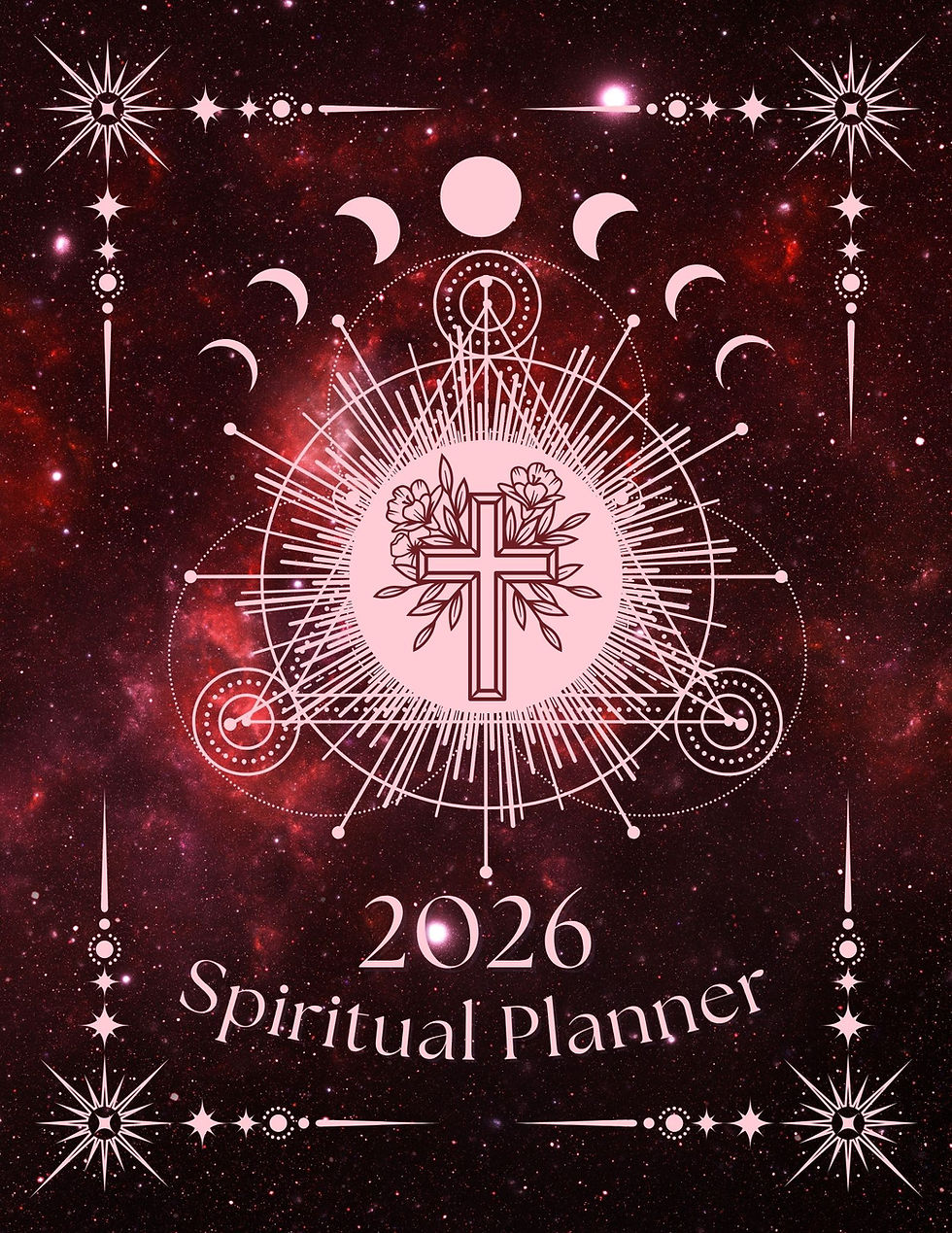
The Christian Witch Tarot Journal is still here—but we're running out fast!
The spiral bound journals are all sold out for the season, but that doesn't mean we're all out of journals! Paperbacks and hardcovers are still here, and this year's planner has all kinds of fun pages like:
3 card tarot pulls
Monthly tarot pulls
Seasonal and holiday information pages
Tips and explanations of common Christian and pagan practices
Bible readings for each week
And a whole lot more! Every day, I get a little more excited to use this here journal, despite still having a few pages left of the first one I made. But I think I've really outdone myself with the changes this time, and I think this'll be especially helpful for people who need a guiding hand in setting up their ritual structure!
And now, let's kick this Christmas eve off with our December questions. Remember: if you have any questions, all you have to do is check out this Google Form right here and fill it out with your question!
Let's get into all this good conversation!
What are God's Spheres of Influence?
Those of us who have researched know that God is not omnipotent in the Bible. So aside from war and storms, what are His spheres of influence as we currently understand God in our modern day? —Michael
Hey, Michael!
I think you may be taking God's origins from an anthropological/historical perspective too much to heart. While the Canaanite deity known as Yahweh was certainly one that seemed fixed to war and storms, the reality is that the Abrahamic God has evolved past that. The Abrahamic God is not just the Canaanite idea of Yahweh; even from a more historical perspective, one might argue that the Abrahamic God is something of a fusion between the chief Canaanite deity El (often represented by a bull) and the storm/war deity Yahweh (more symbolized by a wheel or chariot). The Abrahamic God has thus become something different entirely.
And if you're asking about God's spheres of influence as we understand Him now... then you're asking for the influence of who we call the God of all that is, seen and unseen. God is the Creator; God is Source. As such, His influence touches every single thing that ever was, is, and will be, and a hint of that is visible in the names of His angels, all which seem to hold a piece of His influence over something (like healing with Raphael or war with Michael).
God not holding omnipotence the way people typically interpret that idea doesn't mean that God can't reach into every corner of this world. It just means He can't go against the rules He set for how this whole shinding works—rules He set up, if you believe in the Abrahamic view of God as Creator to begin with.
How Do You Understand God as Source if He's From the Canaanite Pantheon?
How does the idea that the biblical God originated from the Canaanite god Yahweh fit into your understanding of Source and the divine? —Jolea
Hey, Jolea!
Ooh, I'm so excited that you asked this question. It's a great continuation of Michael's question, too. But in essence, as I've continued exploring different deities in Where the Gods Left Off and When Angels & Demons Collude, I've found an understanding that echoes something like Hinduism's idea of avatars: it does seem like the deities we know, in their many forms, aren't exactly transferrable the way some people think (like how the Greeks and Romans believed all other deities were just their deities with different names), but are rather a doorway to Source. They are a door each with a specific key, that key being the tribe/people that is interacting with them. As such, they come to reflect the people who conceive of them and their domains, just as their people reflect them.
For example, everyone is affected by the same sun. We've proved it pretty concretely: the sun is a giant ball of gas out there in the abyss of space, radiating light and heat at us that sustains life on earth. However, every culture has their own name and face to attach to this one sun. Sometimes it's a woman, like Japanese Amaterasu or Lithuanian Saule. Sometimes it's a man, like Greek Helios and Egyptian Ra. What changes between these names isn't the sun itself, but rather the way this piece of Source is understood by the people, and by extension, the way this piece of source mixes with each people. It's like a foreshadowing of what Jesus made plain to us very directly: the Son of God is a mix, and fully made of, both Man and God (Source).
Where this leads into the Abrahamic God is tricky, and I've asked myself this question often: why Yahweh/El (and their fusion, which became what we understand as the Abrahamic God)? Why did this specific mask, or door, of Divinity no longer feel content to be a mask/door? It feels like this one specific facet of Divinity was gunning for the equivalent of a fourth wall break, and like He grew tired of people not recognizing the Source behind the mask (which was a concept that the ancient Greeks and Romans already had in the form of the Monad, and which even Apollo recognized that the Hebrews worshipped directly when he spoke through his oracle according to Robert Louis Wilken The Christians as the Romans Saw Them). It really feels like either "Yahweh" was always something of a Trojan horse in the world of segmented, carved up, masked divinity, waiting for the right time to spring out of the role of minor storm/war god and pull the curtain back on it all, or like Yahweh essentially sacrificed Himself as a classic deity from the world beforehand in order to throw the door open to Source for all people, across all cultures, times, and languages. However, people then forgot that collaborative essence between Man and God, which is why Jesus had to come be that bridge again after essentially breaking that fourth wall severed that connection and that idea.
At least, that's what it feels like to me, and how I understand it.
Is Jesus Just a Failed Apocalyptic Preacher?
Hi Sara, I really love your content, it’s really helped me start to look more into both spirituality and theology.
Recently I’ve been looking into the historical Jesus and finding out that a popular opinion among respected scholars is that Jesus was an apocalyptic preacher, whose prediction was basically proven false. One of these scholars is Bart D. Ehrman, I know you’ve recommended Misquoting Jesus.
So I’m curious, how do you feel about this? Do you disagree with this conclusion? Or do you feel there is a way to reconcile this with the idea of Jesus being divine? There is some scholarship to suggest that Jesus believed his job was to fight the demonic realm as part of this, and I was wondering your thoughts given how you view demons. I’m surprised that, for whatever reason, the evidence that Jesus was a failed apocalyptic preacher, has been the biggest thing to shake my faith in a while. —Anonymous
Hi, there!
Boy, if what some modern scholars say about Jesus rattles you, then you should definitely never look at what the ancient Romans said about Him. (Celsus and Galen in particular were some grade A haters.)
But I'm not sure what you expect. The reality is that the only evidence of Jesus doing any super crazy miracles, or really existing at all in life (and not just as a big what the hell are people talking about? discourse decades after the fact) is in the Bible... and the Bible is not proof of itself. There are centuries of tradition around certain objects and such, of course (for example: in the middle ages, people thought they had Jesus's baby foreskin as a relic, which... is insane). But the Bible is a story, a religious mythology, like any other religious mythology.
Is there a difference between the historical and religious Jesus? Surely just as much as there is one between the historical and religious Buddha, or the historical and religious Muhammad, or Moses, or Abraham, or anyone else. I don't see why historical records, especially considering they're often coming from records of outsiders' thoughts on the budding faith, have to do with how we should take the religious understanding of Jesus as the Word of God made flesh. Our religion has to do with more than what history alone can tell us, and so while it's an interesting angle to consider and incorporate into the Reason side of our three-legged stool of faith (Scripture, Tradition, Reason), it's not really anything to lose your mind over. Jesus is more than a collection of miracles and some oddball apocalyptic predictions.
What Drains our Energy if Not Demons?
Hi! Recently bought Where the Gods Left Off and When Angels & Demons Collude, and I love them, very eye opening. I'm a lifelong Christian that, for lack of a better term, accidentally astral projects sometimes. For the sake of brevity, what is it that drains our energy if it's not demons? Because the demons in your interviews sound chill but I can't reconcile that with the experiences I've had. Thank you! —Anonymous
Hey, there!
So, the thing with demons that people don't often realize is that the demons that have names are nothing at all like the minor spirits running around causing issues. They exist across all cultures under different names: dark elves/fairies, underworld spirits, trickster spirits, kakodaimones, the restless dead, unclean spirits, wind/desert spirits, etc. And sometimes, they're known simply as demons, especially in our modern and largely Christian based culture.
Many of them are their own masters, much the same way wolves and lions and bears are their own masters: they are what they are, they do what they do, and they're part of the landscape. Others, though, are not their own masters, and are rather corralled and directed like goats, cows, or sheep. These are the kinds of creatures that make up demons like the legion Jesus encounters and sends into the herd of pigs: they're tiny things that have their purpose in the spiritual ecosystem, yet can still do damage whenever they're herded in a certain direction, and it's the demon Kings, Presidents, Princes, etc. that have the less-than-glamorous task of herding them depending on what's needed in the world. God Himself can also send evil spirits onto people to test or torment them, like He does to Saul in 1 Samuel 16:14.
They drain energy because they make you miserable. They reveal your flaws and weaknesses to you the way bugs are revealed when you flip a rock over, and that kind of ripping back of the curtain of your own fallibility is a massive hit to your ego. It takes a lot of energy to repress and hide from one's flaws, and even more to be confronted with them the way these spirits do. It also drains you to have pieces of yourself ripped at with the way some of these spirits are just looking to chew on your energy like a dog chews on a bone. But just like we respect the wolf while still not letting it eat us, we have to do the same with these spirits: respect their place in the spiritual ecosystem, but don't let them take a bite out of you.
Does the Episcopal Church Accept Christian Witches?
Hi Sara! I read your book, Discovering Christian Witchcraft, about a year ago and followed you on TikTok. Thank you for integrating two practices/faiths that I have followed in such a way that I don’t have to choose between them. My question is: does the Episcopal Church know of your beliefs and accept you wholeheartedly? I would like to have a church community without having to hide myself. Thank you! —Bella
Hello, Bella!
So, I can't speak for all Episcopal churches here, but what I can say is that mine has been super welcoming. Both on my social media and in my real life church community, I've been open about my magical practice and how I synthesize it with Christianity, and nobody from this denomination has ever given me shit for it (in fact, some of my best mentors, friends, and collaborators in my work are Episcopal priests).
You gotta keep in mind, though, that I'm living in a pretty liberal area. I live in deeply blue New England, where people tend more often than not to be on the right side of social justice (that I've seen, anyway). There are Episcopal churches in less liberal areas that are way less affirming, open, and accepting.
Can You Invoke Jesus to Help You?
Can you invoke Jesus Himself, to guide you? —Anonymous
Hi, there!
Short answer: yes!
Long answer: What do you mean by "invoke"? Help how? You can pray to Jesus and ask for His help, but if by invoke you mean trap Him in a bottle and make Him do flips at your command... that won't really work out for you. If you mean can you call on Jesus alone and not God or the Holy Spirit, well, God the Son is still God, even if He's not God the Father. You're still talking to God, just a different person that makes Him up. (If you follow Trinitarian doctrine, as Christians tend to do, anyway).
Will Discovering Christian Witchcraft Ever Have a Discreet Cover?
I’m really interested in buying your book, Discovering Christian Witchcraft. Unfortunately, it’s not a very discreet cover. Which is not the best considering I’m in a household that would not support my practice. Would you ever consider making a discreet cover in the future? Thank you! —Anonymous
Hi!
This is a great question! I do think one day, after the third book is done, I want to shove them all into an omnibus for people to get in one go, and I absolutely understand the need for more discreet covers. It's something I plan to do eventually, but in the meantime, the e-books of these are always a great choice for folks who can't carry a book like this around!
How Do I See the Bible with Fresh Eyes?
I want to read my Bible again (I have the King James version, not sure if that's the best one or not), but I want to make sure I'm looking at it the right way this time. In the past the church told me how to interpret the verses, and it felt incomplete. What can I do to look at it with fresh eyes, to see and understand how you do? —Jessica
Hello, Jessica!
So, I've written a longer post about this before that may help, but in essence, my advice is to read the Bible like a story. Not like something literal, not like some hard scientific fact, but as a story. This means also picking apart the deeper meaning under the text: what are things metaphors for? What mystical ideas are being laid out in imagery and myth? What spiritual significance do seemingly straightforward ideas hold?
Reading it this way, and breaking it down the way you might a book in English class, is the fastest way to get some really interesting and groundbreaking ideas from it.
How Can We Contact Angels?
Hi Sara! I have been following your work for quite a time, and it made me feel more united with God than ever before, and I wanna thank you for that!
My question is the following: How can I get more close to my guardian angels and communicate with them? I feel they send me messages from God quite often when I'm in trouble. I also feel a calling from the archangel Gabriel; how I know if it really is him and what can I do to know what does he want me to do? Thank you! —Aleksander
Hi, Aleksander!
So, with angels, the first thing one has to remember is that angels answer to God first. As such, if you want to talk to the angels, it makes sense you'd ask God's permission for them to contact you and for you to contact them. Not every angel is necessarily trying to speak to you directly, but guardians are typically always there and, if God wills it, can give you hints and redirection. They still are focusing more on keeping you alive than just chatting, though (at least, my guardian is).
With Gabriel, he's an angel associated with the color blue, the element of water, the moon, and with writing and messages. His name also means "God is my strength." If you find any messages coming through that have to do with these kinds of symbols, it may be him, but the easiest way to know for sure is to ask God directly, because it's not Gabriel just acting out of turn: it's God that's sending him your way for whatever reason. Go directly to the Source to figure out the issue, and then get permission to keep doing that one-on-one action with Gabriel if it's really Gabriel that's floating around.
What Are These Evil Spirits Psychics/Ghost Hunters Encounter?
Those ghost hunting shows like Kindred Spirits and psychic mediums like Chip Coffey have experienced dark entities that oppress families and people, or they plant evil in mind, etc. What are these entities then? if us, witches, work with the infernal and demons and have no problems, what are these entities and "demons" ghost hunters, psychics and people claim to be really bad? —Anonymous
Hey, there!
So, this question is interesting to me, because it has an implication within it that these psychic mediums and stars of T.V. shows are at all, in any way, being truthful and not just hyping up their experiences for the drama of the show. If we take the T.V. show angle away, then it implies that anyone calling themselves a medium or a ghost hunter, show or not, is inherently an unbiased or trustworthy source of information.
I would argue both of these are entirely untrue.
When I was young, my mom and I would watch all those ghost hunter shows together, and looking back on them as an adult, I can tell you that they're so manufactured that it's just comical. For the sake of ratings, exciting things need to happen, and that means that there may easily be manipulation behind the scenes to cause big noises or other events to get people to keep watching. These T.V. shows aren't charities; they're trying to gain notoriety and fame (and, most importantly, contracts to keep running their show).
But even if we have a psychic medium or ghost hunter with no show to incentivize them to lie, the reality is that these people are not unbiased sources of information; they are not people whose spiritual understanding was created in a vacuum, and therefore they have all kinds of baggage and misunderstanding that they either haven't worked through or haven't realized they should work through. They might warn people away from the very same demons others successfully work with precisely because they haven't unpacked what it means for a spirit to be a demon in the first place.
Does this mean there's no such thing as dangerous spirits? Of course not. However, it's the difference between acknowledging that wildlife is dangerous but necessary, and believing that, for example, wolves are inherently evil and should all be avoided or even hunted to extinction. If you're careful, you can have a beautiful (and safe) experience with local wildlife, especially if you have guidance from trained wildlife experts. If you're not careful and decide to go touch a moose that's clearly on high alert and acting defensiv, then claim all moose are evil when you get your shit rocked, that is frankly on you.
But most often, in my humble opinion, a lot of these "spirits" oppressing people are 9/10 times just the projection and externalization of one's own psychological issues (or "shadow," to borrow Jungian terminology). It's much easier to blame a demon of wrath than admit people just have anger issues, y'know? The last 1/10 time, there might actually be a spirit that for some reason got hostile with someone, but that's a case-by-case basis and much more rare than people think.
Ask Your Questions!
Remember, all your questions can go to this Google form, so don't hesitate to reach out! I'm looking forward to seeing what questions people have in the future, and I hope this has been a helpful read! Thank you everyone who participated!
—Sara

Sara Raztresen is a Slovene-American writer, screenwriter, and Christian witch. Her fantasy works draw heavily on the wisdom she gathers from her own personal and spiritual experience, and her spiritual practice borrows much of the whimsy and wonder that modern society has relegated to fairy-and-folktale. Her goal is to help people regain their spiritual footing and discover God through a new (yet old) lens of mysticism.
Comments