


The Vampire x Witch Romance of Summer 2026 | This is My Blood SNEAK PEEK

Updated: Jul 25
It's almost time for this bad boy to drop!


Alright, y'all, I'm sure you've been hearing me talk about this book long enough—but given we are two weeks away from release as of today, I thought... why not give y'all a sneak peek with the first (technically) three chapters?
(That first bit is something of an intro to the intro, so I don't really see it as separate to the next part, but it's still technically a chapter.)
In these opening scenes, we meet our main characters:
Elias, the 586 year old Greek vampire, and
Nadia, the 33 year old Polish-American witch.
(And of course, we get a little side-character action in Nadia's scene, too. Lily and Lyle, watch out for those two.)
However, yes! As you might've guessed, this book is dual POV, with Elias and Nadia navigating their wild hang ups together over the course of this narrative—and this catalystic moment is only the start of a wild ride.
I just love them so much that I wanted y'all to see them—especially given we have this one fantastic piece of art done by @strawberrys.art on TikTok and Instagram! (And honestly, this art gave me the inspiration I needed to see this book through when the work was killing me.)
By the way, if you haven't pre-ordered a copy yet... did you know when you order from my site, you get a little thank-you card with this lovely art on it?
Now, without further ado... the first three chapters!
Thursday, June 17
1462
The wrath of God burned across Wallachia’s black sky, and Elias knew it was coming for him. For him and all his wretched company.
Yet he ran on. Tears streaked down his cheeks. His hands reached for someone, anyone, all while stiffening into hook-like claws. The streaking heat of the Lord’s fury dried out Elias’s skin; it stole the tears from his eyes, forcing his eyelids to scrape open and closed with every blink. Choking smoke buffeted him, and the stench of burning hair reminded him of every image of hell he’d ever known. Garbled cries of men made a wicked overtone to the singing of steel on steel, as did the rip and tear of cloth (and perhaps also flesh). But worse than any of these individual horrors was the throat-shredding, teeth-stinging thirst in Elias’s throat.
What he wished for, in the middle of all that horror, was the Communion cup. He hadn’t been allowed to drink from it in years. If he was to die out there, then that cup would’ve been balm to his soul, one that took him off this field and brought him back to the little church of his youth. It would've been a proper homecoming after so many years training under Ottoman generals and imams, pretending to follow the faith of Muhammad as a member of the Sultan’s infantry. One sip of the blood of God’s own Son, and he could’ve pretended he was back in the hills of Greece again, with his family—his sisters and his parents. Maybe then, he could have forgotten the teeth that had punctured his own throat.
At the very least, the Eucharist might’ve washed away the taste of the black blood that Vlad Țepeș poured into his mouth after draining him to near death.
Elias’s bare feet thundered over the drying grass and sharp stones. One blink, and he found himself in the middle of the chaos of the Ottoman camp. He wished for it more than anything: the sweet, syrupy Blood of Christ—
As he looked up, as he tried to hide from that red sky and orient himself in the stink of steel and iron, he saw his fellows pounce on a soldier and tear the chainmail from his armor as easily as silk from a dancer’s chest. Elias’s throat begged for it: for the Blood of Christ—
Another of his comrade’s two white teeth shone in the fire before they sank into an Ottoman soldier’s neck, and it was all Elias could think of: the Blood of—
That scent in the air—it smelled less like iron, more like fruit. Like roasted chestnuts, smoke and bitter coffee. Like something that might sustain him. Heal him. And he thought of—
The blood.
“Pull back!” One soldier’s shouting ripped Elias’s focus back to the burning camp, and he stopped hard enough to send dirt and stones spraying in the soldier’s direction. The soldier held his shield close to his chest, his curved kilij pointed at Elias. Despite the firelight burning his eyes, Elias could see the way the soldiers face pinched—though whether because of the smoke, or fear, or hatred, Elias did not know. The soldier’s voice boomed over the chaos, “Pull back! Get the Sultan to safety!”
The Sultan. Yes. The blood of the Sultan—that was what Elias wanted. The blood of he whose laws took Elias from his weeping mother over a decade ago, forcing him to abandon his parents and two sisters in their village of Galatissa—that was what would deliver him from this thirst, a pain so deep it hurt to breathe. And the life of he whose armies ever expanded with sons like Elias, and who would throw them into the endless task of expanding the empire—yes, that life would pay for these sins. That life would be worth enough.
But first, a small drink was in order. A little relief, so that he might look on the face of that Sultan with eyes that didn’t sting so sharply in all this smoke.
Elias’s eyelids scraped over sticky, bone-dry eyes. One skipping blink, and his arm stretched out. Another blink, and he’d taken that soldier in his grip. A yelp, a cry, another blink, and the soldier’s shoulder had been dislocated, his sword useless on the ground. All the noises blended at that point: the twang of swords clashing, the thwip of arrows sailing through the night, the crackle and crunch of tents and pole arms burning to cinder. Elias didn’t pay them any mind. He only dug his nails into the frozen soldier and pierced the suddenly exposed skin of his neck with two long, sharp teeth.
Then came the flood of life onto Elias’s tongue—a taste sweeter, richer, than he’d ever known from any Communion cup, one that cooled the heat from his skin and muffled the chaos ringing out around him. He pulled life through that soldier’s veins, feeling the beat of his heart slow with each drag in such a way that made time itself seem to slow, until there was no sound at all around Elias, no stench, no heat, no horror.
And then, when Elias reached the bottom of this man’s life, he thought he tasted something more: something golden, warm, as if a star were buried at the bottom of his being. It stung his teeth to come so close to it, and Elias knew he had to let go.
But as Elias dropped the pale corpse into the dirt, the burn in his throat did not fade. All the blood in this man was gone, and yet it was not enough, not enough, not enough. He clawed at his throat until it bled, and his hands came away the same shade of black as the stuff that flowed from Țepeș’s wrist. A mangled cry rose from Elias’s throat.
Cursed. The thought speared him. I am cursed.
He knew it then: he was outside of the sight of God. Lost, gone, no longer one of His creatures. Yet no penance came from him, because there was no life left in his own heart, no way to break it and make it contrite, that he might offer it up to God in sacrifice. Nothing he could do would be enough to cure him, restore him—not enough, never enough, said the burn in his throat. The sky raged with the fire that swallowed the camp, the smoke stung his eyes, and yet it was the thirst that made him start his frantic rush across the camp again, claws hooking into the cold steel of another soldier’s armor—
Again, and again, he experienced the slow fade of the heartbeat, the limp and dead weight of the soldiers. Blood flowed into Elias’s mouth, and the destruction, murder, death—everywhere, it followed him: fire, the rending of flesh, stones spearing his feet and blades clipping his limbs, his stomach bloated and sloshing with stolen life, little more than a waterskin—
Worse, every moment, a hissing command hooked into his mind as if from the Devil himself: the Blood of Mehmed II, the Blood of Mehmed II, the Blood of Mehmed II—
His thirst did not let up. Hands sticky with blood, it did not let up. Stomach full to bursting, it would never let up. As if the scratch of smoke had permanently stitched itself into his flesh, it tormented him, and he could only keep running, keep reaching, keep killing, until the screaming made him go deaf, and until one great beast of a soldier finally stopped Elias in his tracks with the glint of his axe.
That glint arrested Elias’s attention for but one moment, and that moment was all the axe needed to find its path to his face.
PART 1 | THE COLLECT
Friday, December 12
2025
It was the thirst that woke Elias, not the axe.
In his bedroom was no smoke, no fire, no Turks or Romanians. Only darkness and clean, soft sheets. The aftermath of that “night attack at Târgoviște,” as historians would come to call it, disappeared from Elias’s thoughts. Every part of it, even the axe and the big boar of a soldier that swung it, he once again buried in the deepest parts of his mind, along with every other piece of his past, until all that remained was the endless present. The future did not exist yet, and the past, he could pretend didn’t exist at all.
At least, he could pretend until the thirst became unbearable and dug up that one memory of Wallachia again. That God-forsaken thirst had been seared into his throat forever, and his name was shackled to the House of vampires that started this nightmare: House Dracula. He was the only one left that could claim that House’s cursed lineage, therefore its patriarch by technicality—and so from that name, and this thirst, he had no escape.
How long will this haunt me? Elias let his eyes slip shut. How many more years of this?
Once, he had this nightmare every night, and he would wake flailing out of the way of the phantom axe until he tumbled to the floor—but for the past couple of centuries, the nightmare only occurred on the monthly anniversary of the Wallachian voivode stealing his humanity. It never failed. No matter how much he pressed the memories down, buried them under pages upon pages from humanity’s books on science and language and culture and history, here he would be again: remembering every detail of the smoke, the steel, the blood. Waking up parched, yet drenched in terror and despair.
He sighed. The cold silk pillows and the soft blanket did nothing to soothe him, and neither did the perfect darkness thanks to the light-blocking, mechanical window shutters. Despite the dark, however, Elias could still make out the shapes and colors of his furniture, as well as the books and papers and maps and other things strewn about the bed and the floor. Elias’s curse afforded him the clearest sight at night. It won him kinship with the shadows, too; he could disappear into them and erase the borders of his very being. In the shadows, he could become anything: the darkness itself, or perhaps a bird, or a spider, or a mouse. And like all vampires, regardless of their House, Elias had a silver tongue, with which he might convince humans to cut their own throat and empty it into a glass for him if he asked. And he’d asked many times since fleeing Wallachia.
These were the gifts of hell. So he heard everywhere he went since that night in Wallachia. His gifts were the blessings of the Devil; they were from this rebellious angel’s fiery home, where priests proclaimed that the souls of the damned were tortured forever, and where his soul, according to legend, already laid, waiting for his body to join it deep in the earth to begin his eternity of suffering. All the Saints and monks and priests said as much: that hell was down below, and hell was where creatures like him were destined to be judged, punished, and ultimately destroyed by the one true God. Elias once believed every word, what with how the sight of the cross made his eyes ache, and how hearing the people’s prayers made his skin crawl.
But in all of Elias’s earlier fears of death, and all the torment that might come after, he knew that whatever his soul suffered in hell, his body didn’t fare much better. He could bury the memories, but his body was still heavy with everything he’d done: hiding under the heavy lids of coffins with worm-bitten bones for his bedmates, burying himself in the earth to survive another hateful day, dodging crowds of people until he could find one sweet enough to tear open in an alley, washing his crimes away in slimy, stagnant pools and stashing spoils of men’s gold and silver in his eventually better, finer pockets…
Even centuries later, the luxury of a clean, silent home still felt like the real dream, as if his body were still turning in the muck somewhere, on the outskirts of some hamlet that couldn’t protect their sons and daughters from his teeth anymore than it could a bandit troupe or a neighboring land’s army.
With a deep sigh, he stretched, and his foot knocked into his latest fixation: a book on astronomy. It tumbled off the bed and hit the ground in a flutter of pages and a dull thump. Books like those were the only thing that kept him sane in the sameness. With so much noise and color to fill his head with, such as those glossy photos that demystified the ancient sun as nothing more than some ball of combusting gas, he could push everything down into that singularity in the back of his mind, dense and far removed within him. Did he absorb all the information he read? Not necessarily. To know wasn’t the point. Only to numb.
The thirst made each breath whistle past the dry flesh of his throat until he couldn’t ignore it any longer. Elias willed his leaden arms to move; he rubbed some semblance of life back into his face and groped for his phone on the nightstand. He didn’t dare swallow, or even move his head, lest he cause a furious crackle of thirst to skitter down his throat like embers.
The light of his phone was at its dimmest possible setting, and yet it still made him squint when the screen flashed to life. He found the only contact he regularly texted and sent the same message he’d sent every month:
The thirst burned him even without moving his head now, as it did whenever he’d gone too long without blood. It seemed a month was his limit; no matter how old he grew, he couldn’t pass that summit or extend his tolerance for this burn any longer than that, unless he went into a years-long sleep. In the history of the text conversation was evidence of that pattern. The last time he’d sent this message was November 12th, and before that, October, and before that, September—all the way back to February, when he’d gotten this phone.
He didn’t wait to see if those two check-marked bubbles lit up to signify the message had been seen. Elias finally pulled himself from bed, swallowed once, and felt his throat erupt into hell’s promised torment. He did the minimum required of him on any given night: wash up, dress in clean clothing, and finally, check his list of meetings, e-mails, and other such noise as was required to run a winery with a particular clientele. Such was the life the Southern New England Council of Vampires fitted him with, allowing him to camouflage and explain the wealth he’d gained in centuries of killing and robbing his victims. This was a world where every dollar could be tracked electronically; the humans made ever tighter nets, ever more omniscient surveillance, as if they hoped to compete with God as to who could know more, see farther. But Elias didn’t mind. The balance sheets, inventory numbers, distributors’ contracts, e-mails—they, too, were cold, impersonal puzzles that made it easy to live one day at a time.
As Elias left his bedroom, he scrolled through such puzzles in his inbox with one hand and tapped the shutter button in the hallway with the other. Within a moment, the kitchen’s shutters opened, and the dim evening light leaked in, carving soft rectangles of grey, near-dead light onto his floor and dining room table. He didn’t bother to watch how the fading light danced on his patio, or the little pond down the hill. Nor did he bother to scan the lifeless living room or its long dead fireplace. The only room that caught his attention was one that had stayed as pristine and orderly as it had for the past five years: the room of the little orphan girl he’d taken in at the demand of his one-man House’s sponsor. She was grown already, in college, and yet it felt like only a week ago that he shared this old house with the golden-headed child named Aurélie DuPont.
Sometimes, when he stood in the doorway of that bedroom, he thought he could see how the room used to look before the creature decided she was grown: the nauseatingly bright pink walls, the poorly painted roses and tulips of a child pretending at being an artist, the bed full of all sorts of strange stuffed monsters and fairytale creatures, the computer desk in the corner littered with papers and crayons she never cleaned up. Those times were the only ones that Elias let himself remember against the monotony of his life: the times when that delicate child crept through the house, experiencing this tired, aching world for the first time.
She’d been such a mouse. For all his attempts to steward her, as he’d learned to do from the books on child psychology he’d collected to prepare for this burden, she feared him more than any monster she might’ve convinced herself hid under her bed, and understandably so. She’d been a victim of a certain House’s inter-family feud, and the DuPont vampires were scattered to the wind, the human pledges and retainers slaughtered. His sponsor's men found her hiding under the floorboards, her parents’ blood soaking her nightgown, and for her safety, they’d renamed her Rose Nadeau and labeled the DuPont child dead.
It took years before Rose could look him in the eye when he spoke to her, even though he attended to her every need and poured all he could into her home education, her entertainment. He cooked food for the first time in centuries, listened to the girl’s every story, real or invented, and answered her every question—all so that he might repay his sponsor, that Matviy Vovk, patriarch of the Ukrainian Diduch House. Elias had glamored his way onto a ship and come to the new country of America in the late 18th century, docking in Rhode Island, and Vovk took the lone vampire under his wing. Elias had been repaying his philanthropy ever since.
And nobody could claim Elias hadn’t done right by the child. The proof was in the house’s silence. Her room had none of its old cheer anymore. The walls were painted over, grey-purple covering the old murals; the bed was free of toys save for one ratty purple monster, and the computer desk had nothing on it save an old monitor. Rose had long since packed her things and found her own nest to build up, somewhere nearer to her workplace—his winery.
He lingered in the doorway of Rose’s old room a moment longer, then pulled himself away to attend to his business. He snatched his keys, sunglasses, and wallet from the book-cluttered dining table, then braced himself for the discomfort of the evening’s last scrap of light. It took only a moment to reach the shelter of his car and its dark windows, but that was all it took to make his skin feel too warm.
Tinted windows weren’t legal in Rhode Island, not technically. However, one benefit of Council membership was that they had a talent for bending human law. The tint on Elias’s windshield and windows was much higher than the thirty percent allowed by legal exception, and yet not once had he been pulled over. Even speeding, as he was then down the quiet streets of his neighborhood in Scituate, no officer would stop a black Lexus RC F with his license plate. What were his Council dues for, if not for peace from human meddling?
The fifteen minute drive to Elias’s vineyard was a route he’d done many times. He passed under streets with trees thick enough to mask the nearly faded light, and he crossed over the Scituate Reservoir, a great body of water that threatened to blind him with how it glittered when the moon was full.
Despite modernity, it seemed the memory of colonial England’s hold on the region never fully faded. This flat, marshy hamlet of a state had its forests and brooks and bays largely unbothered in many areas, only to eventually bleed into neighborhoods of little farm-like homes with flat green lawns and short stone walls. Eventually, those gave way to grey eyesores of intersections and city streets, where humans drove with the grace of beetles in flight and about half the wits of them. On these often pockmarked, poorly mapped, and highly trafficked roads, Elias found himself thankful for the sharp reflexes of his kind.
Soon enough, Elias’s wheels left (somewhat) smooth pavement and crunched over the dirt and gravel of Belevonis Vineyard. Elias Belevonis, so did the human authorities know him: the son of Greek immigrants from a long time ago, with a tradition of naming their sons Elias into oblivion. That was one of the only pieces from Elias’s human life he still retained: the name his father gave him. That, and the richly bronzed skin from his mother, darkened further by his life working the fields and preserved that way forever after the voivode’s curse took hold of him. Her family line came from a much older empire than the Ottomans, one further east.
Belevonis, however, was no more his true family name than was Fountas, or Arsenis, or Dimakos, or any of the many surnames he’d worn like coats before. He’d forgotten his true family name, knowing only that it was Greek. Other than that detail, the name itself was of no use to him anymore; his family had long since become dust in the ground.
The winery was, in the front, a humble place: the building was fashioned like a big brown farmhouse, with a pointed roof and wooden shingles, as well as wooden support beams. Potted plants and shrubs gave a hint of green. They’d been decorated with string lights and other such nonsense to mark the holiday season, and a signboard had holiday deals written up in white and red chalk by some day waitress with a delicate, artful hand.
A great emblem hung on the triangular space above the vineyard name: the emblem of a man with grape leaves and vines wound through his long dark hair and dark beard. It was Dionysus, a heathen god of his people that he didn’t find any more kinship with than he did the God of his dead family. But Vovk insisted on this imagery for a Greek winery, and so Elias had the art commissioned.
With the sun fully set by then, golden light poured from large wall-sized windows, radiating off the thick beams of warm wood and sparkling off the bottles and grapes on display in old wooden crates. Past the front doors, the grey stone of the fake fireplace was creased with shadow, and it roared with a little gas fire to warm guests as they decided if they wanted to peruse the shop on the left side of the building, or meet the hostess to sample those wines in the dining room to the right.
The last few patrons of the day service sat at thin-legged high-top tables, picking at platters of cheese and sipping the last of their wine flights from little glasses set on wooden trays. The staff all moved around them with the same grace: smooth steps, languid nods of their heads, and slow swishes of their arms as they explained the winery’s offerings. They displayed the same mechanical mannerisms when they cleared tables or took away old dishes, and all of them had a serene smile on their face, bewitched by Elias’s glamors into the picture of perfect service.
He would soon be due to inspect his glamors on the staff—both this transition team, and the night crew proper. His car’s interface told him it wasn’t yet five o’clock, but the coming winter weakened the sun, giving Elias more time to prowl about outside—and more time to suffer this thirst when it struck. Once he parked at the edge of the winery, where a single wooden arbor marked the entrance to the vineyard itself, he hurried from his car and disappeared down one dark, barren side path.
Even if Elias hadn’t worn a coat, the cold wouldn’t have stung his flesh, nor could it threaten to take his fingers or toes or nose. He was dead, if the stories of humans were true. Even though he breathed, walked, and talked, it was all but an illusion—and he could believe that, as his body couldn’t process any human food, and for all the blood he could drink, even if he drank a glass every day, his veins never grew warmer than tepid water.
He hurried down to the south edge of his land, where one lonely, sagging shack sat at the property line. The line itself was marked by a border of thick, gnarled, forest. There was no one to see anything he did here, save for the occasional deer or fox running through the woods.
As he got closer to the shack, however, he hesitated. The smell of blood soaking old wood affronted him. It was strong enough that his fangs stung with venom without even being near his victim, and no doubt, if he came any closer, it would be strong enough to addle his mind the way his wines did to humans after a full flight. His shoulders tensed, and he hurried on.
The runt he’d texted, some fledgling named Liam Cormier, must’ve gotten carried away. Like Elias, the boy seemed to have a penchant for ignoring his thirst until it grew too much for him, even though Elias gave him free reign of the bottles of blood they served to the night clientele. It was as if the boy thought he could avoid his nature, or stall it somehow, stubborn as he was. Elias had thought like that once, as well—that he might refuse to rip any more life out of humans, and that he might starve himself, control himself. That he might reform himself and avoid the hell he heard the monks and priests and exorcists rave about.
The thirst always won. Even nearly six hundred years later.
Yet no matter how many times Elias tried to tell the idiot boy these things, he still insisted on staying “dry,” as he called it—as if this false dignity meant anything, given how he’d burned his own House down in Louisiana and fled north with nothing but the shoes on his feet. If Vovk hadn’t been so keen on rehabilitating abandoned, House-less vampires and vampires-to-be, like Rose and Cormier, then Elias never would’ve had to bother with this sullen boy. Unfortunately, it seemed part of the price of Vovk’s support was that both his home and his winery had become the boarding houses of vagabonds.
Something rustled near the tree line. Elias paused, wondering if perhaps Cormier had already tried to leave—but when his head snapped towards the noise, what he saw was no man at all. Rather, it was a goat: a black goat, with striking yellow eyes that shined like a low moon. In the light of this night’s moon, however, its oily fur shined, and it flashed its horns at Elias as if threatening to charge. When Elias shifted towards it, intending to chase it away from his vineyard, but then he stumbled.
His ankle got caught in thorny, dry bramble. When Elias inspected the shack’s edge, there was a tangle of black vines he couldn’t quite distinguish from the black, frozen earth. They snagged his shoes, and then, as they somehow crept up his pant leg to scrape their thorns against his skin, the plant’s oils stung him. When Elias tore himself free from the plant’s poison barbs, he looked up to see the goat bound away and vanish into the trees. Or, rather, dissipate. It moved so quickly that it might as well have been little more than mist fading into the shadows.
Elias shook his head as if that would make the image any clearer in his mind. It didn’t, but at least the goat was gone; he’d check for it again later, to make sure it stayed off the property and kept his vines out of its mouth. A deep drink would have fixed the pain in his ankle, as well as the sting crawling up his leg, but of course, the castaway vampire had ruined that. He’d have to find something to drink later, before whatever coated those thorns irritated his skin further. Elias threw the shack’s door open, intending to remind Cormier of his place.
But a flash of light seared his eyes. He squinted past what he realized was the violent orange glow of candles. They littered the shack; every spare surface was covered with them, and they made cruel shadows dance in the shack rafters. Perhaps they were the ghosts of the dead that Elias left Cormier to dispose of, what with his former House’s gifts of rot and plague.
The candles weren’t on every surface, though. As Elias blinked the burn from his eyes, he scanned the worn-down shack and discovered no bloodless body on the old office desk, like he’d expected. In fact, nobody was there: neither Cormier, nor the human he expected Cormier to find for him. Instead, what he found were a few red candles, several shining apples, a couple cracked pomegranates with seeds glittering in the candlelight, trumpet-like white flowers, and a polished silver chalice. What looked like a red velvet drawstring bag sat in the center of the desk, surrounded by red rose petals.
Around the shack, there was no smeared blood or any sign of struggle: there were only yet more pillar candles melting wax on the floor, their flames dancing on the wicks. He stepped inside, confused, but when he stepped in something sticky, he looked down and discovered where the smell of blood was coming from.
The scene startled Elias. The blood wasn’t just spilled on the floor; it was painted into a circle, with odd symbols and shapes that he didn’t recognize. It smelled like more than blood, too, and it was darker than blood, as if it were mixed with something like tar. Whatever it was, the tar smelled like cinnamon, roses, and something else that was bright, floral, yet sweet. The scent of the blood floated above it all: a vibrant tang that reminded him of orange peel and young cognac mixed with iron. The scent electrified him; it was the scent of someone brutally alive, spitefully so, and it scraped along his lungs, burned itself into his memory.
He stepped closer to the desk and found the scent of blood coming strongest off that pouch. The chalice behind it, however, he couldn’t come close enough to investigate. Just breathing in that blood’s fiery scent branded him, parched him beyond reason. His mouth pooled with venom. He tried to shake the growing haze off his mind, but it lingered and made his vision smear more with every blink.
Those flowers, are they—?
The white trumpets might’ve been datura, in which case, whoever had come to this shack was a fool that could’ve easily injured themselves vandalizing the place. Still, Elias was fascinated. How neglected did the shack look, that some superstitious creature thought it would be safe to play make-believe undiscovered here?
All this mess was the work of someone apparently unaware that they lived in the modern era of human science and reason—someone who still believed that wasting resources and lighting candles would summon some great Other from the void beyond. The care taken in this arrangement was clear, everything in its right place, the offerings expensive and beautiful, the soft light of the candles letting flame and shadow mix together like oil paints. Whoever had done this might’ve read the same printings he’d read centuries ago, when he was still naïve enough to believe the men that claimed they could breach God’s hiding place with all their physic and philosophy, their magic and miracle.
But for what purpose?
Elias could only wonder. It made his lips twitch into the smallest smile. He’d wanted so badly to believe in these things once. His existence was proof that there was something out there, some strange and terrible force he might’ve learned to use—but for all the texts he studied, and the lectures he listened to, none of them brought him any closer to the thing people called God, nor gave Elias a way to demand any answers of it, or to fall before it and beg for mercy.
So what were you hoping for, vandal? He could make no sense of the symbols on the ground. To what end?
When he turned to find Cormier and have him clean this up, however, he found the door shut. He knew he hadn’t closed it, nor had he heard it close. He hadn’t felt anyone’s presence nearby, either, whether living or undead like him. He was alone.
When he tried to step outside that sticky ring of blood and tar, so that he might find whoever created this strange scene—they must still be nearby—a violent sickness took hold of him. Elias’s temples broke out in the black, chalky sweat of a starved vampire; his legs buckled as the disorienting haze deepened, landing him hard on his knees. His throat burned—his lungs burned—and he clutched at his shirt collar as if that was choking him rather than this scent.
“Well, look at you.”
The voice crashed on him, tinny, reverberating in his ears, and yet he could tell that it was a human woman’s voice. With great effort, he shuffled on his knees and turned back towards the desk—and a wordless rasp of surprise raked up his throat. It was drowned out by the voice’s next words:
“Just as the hound finds the mallard in the field, so too will you find me in the waking world.”
What?
There was a human standing there—or rather something human shaped. She looked as if she were made of a bubble of blood; Elias could see the desk through her, and from where he knelt on the floor, the little red pouch glowed where her heart should’ve been. When she moved to pick up the chalice, it was with the grace of some spirit from a dream, and though she wore an owl mask, her body was naked.
It’d been ages since Elias bothered to look at the women he killed, but it was as if she’d anchored his eyes to her with whatever strange power danced in the air. It forced him to look: at the curve of her small breasts, at the swell of her hips and the way her collarbones made stony tips at her shoulders, of the harsh angle of her waist and the way her skin stretched over her ribs, and the long nails that added unnatural length to her jagged, veined hands. Her shoulder-length hair fluffed around her owl mask, straight and straw-like, giving her the impression of some late autumn spirit of the forest.
Beautiful.
He witnessed this vision with nothing short of awe. It was likely those datura flowers that warped his sense of reality—either that or the same madness that eventually killed the rest of his troupe from Wallachia. The thought filled him with dread, even for all the specter’s loveliness. Was it truly inescapable, the madness? Was it bound to find him eventually and rob him of his sense, like he’d seen happen to the other Greeks and Bulgars and Slavs and Turks who crossed the voivode’s path?
Those men, like Elias, lost the right to go home to their families because of this curse. Yet many chose to live like ghosts: watching their families go on without them, watching wives take new husbands, watching generations of children age and die while they still lived, and watching new lovers wilt in their hands every fifty years or so—if those lovers didn’t trap them and lead the church to their doors first for gold. Elias thought he could avoid that fate, what with all his life’s carefully curated monotony, but… was this the specter that stole sanity from them all and drove them to hell? This bloody she-demon with the owl mask?
He wanted to reach out—to see if his hand would pass through her, or if it would land on the soft curve of her hip. He wanted to know if that glowing thing in the center of her chest would feel like a heart or a living flame, and he wanted to take that mask off, to know if she had any face underneath it. He had to know, in fact. Had to know who, what, this creature was—had to steal her away and spend weeks pulling her apart thread by thread, understanding what this illusion was, consuming every scrap of meaning until nothing more could be drawn from it.
And then he noticed the shadow behind her that nothing could’ve cast: a shadow of two great horns that stretched up the wall and scraped the ceilings. It’d been several decades since Elias felt a chill run down his spine like it did then.
It’s the datura. It had to be the flower’s doing, he told himself, it had to be—as why else would he sit here, parched to the point of dying, dreaming of some she-demon at an altar of blood and pomegranates?
“Just as the body will wither without its blood,” she whispered, and she pressed the chalice to his bottom lip, “so too will you wither without me.”
She tilted the cup, and something flowed out: something thick, milky, sweet, and cold. Maybe long ago, he’d tasted cream like this on his family’s farm, but he couldn’t remember. He tried to reject it, but it slipped down his throat so quickly that he had no choice but to swallow. Past the sweetness was the tang of metal—and the faint hint of citrus, the sting of liquor.
“Just as the turtledove stays faithful to one love,” the specter whispered, “so too will you be faithful for all the rest of your days.”
To his shock, the freezing liquid coated his throat and erased his thirst. He could’ve even imagined he saw steam puffing from his lips. But the relief that filled him, the cooling rush of whatever he’d drank, it ran down his throat and into his lungs, into his stomach, until his entire body slouched and stilled. Then a white haze stretched over his vision and blinded him. Yet he felt no fear. Not when the white nothingness looked so much like the deep, endless winter storms he longed to disappear into every year.
His mind buzzed with stray thoughts. Perhaps he would go permanently blind, and he wouldn’t have to see anything anymore: no convicts and runaways to feed on in this shack, no wineries and all the humans crawling around inside, no vampires replacing them after hours and sinking their teeth into his bewitched and clueless staff. No more Rose.
No more of her quiet sadness that she thought he didn’t notice when she sat behind her work desk. No more of her grief for her slaughtered parents that he could not make her forget in the fifteen years since he’d taken her into his House—or for her own humanity, which she’d give to him in the coming October, per the agreement Vovk burdened both of them with. She would be the first human he’d ever turned, and he refused to imagine that far-off day.
In that moment, there was no need to think about anything beyond the quiet. He might’ve stayed in that shack for eternity, for once feeling something fuller and softer than the sharp-edged emptiness he’d guarded in himself night after night—but then the chalice fell from his lips and clattered to the ground, and as his sight bled forth again, every single candle flame disappeared, along with the she-demon.
Every flame except one. It continued to dance behind the desk. Its red-orange light crept up the wall, reached so high, yet it couldn’t chase away all the shadows by the ceiling; its red-orange light bled into black nothingness.
The colors of wrath.
Seeing that light ripped Elias’s peace from his chest and shattered it; he expected to hear the clash of swords again, taste the smoke in the air. Then, in all that fury, he saw not a shadow, but true horns appear from the nothingness—black, gnarled things, resting on a head of shining black hair. That hair framed a woman’s pallid face and dark eyes, and the whole head came down from the ceiling on the body of a snake.
Demon. It was all Elias could think, and it made his breath pause in his lungs. A true demon—here, for me—
“Do you see me, leech?” The demoness cocked her head. Her wine-red lips parted, revealing white, sharp teeth. When Elias’s gaze fixed on her and tracked her head as she waved from side to side, she smiled wider. “Good. It is done.”
Then the head retracted into the shadows. The final candle snuffed itself, and the strength dissipated from Elias’s body. He fell over, exhausted, and he slipped into a darkness so deep that even his vampire sight could make nothing out.
Saturday, January 3
2026
Nadia didn’t think she had that many requests for the new year. All she’d cast on the eve of St. Lucy’s Day was a money spell, a love spell, and a spell based off the Tower card in tarot, just to shake her boring routine up a bit. What could go wrong? she’d thought—and more than that, she wondered how long it’d take to see any results.
Granted, they were only three days into the new year, but she kept her eyes peeled for signs anyway. At thirty-two years old, Nadia hadn’t done much with her life; she was still just a part-time adjunct professor with a little bar-tending gig on the side. At least at the end of the year, she’d shot off a bunch of Ph. D. applications to her top schools, but she may as well have sent them to the void. It was anyone’s guess what the responses would be. She had no sign of what would come, no idea where her three spells would take her, and it wouldn’t be long before her patience wore out. Another week, and she’d wonder if God heard her requests in the first place.
She tried not to think about it while she was behind the bar that night. After she’d set a beer-drunk college kid up with a glass of water and put in his pretzel order, then taken some office man’s order for a sidecar, Nadia surveyed the little Providence pub. The Lucky Lobster, it was called, which she thought was a name that made more sense in Newport or Middletown, or the cute parts of Westerly and little Wickford village, but she supposed nowhere was really that far from the ocean in the Ocean State—not even Westminster Street, with its fairy lights running up and down the brick-lined roads and shining off the windows of shops and restaurants like this one.
The nautical theme of the bar, with the sailor’s knots, little anchor motifs, and lobster cages, went well with the warm oak counters and the wooden paneling, as well as the brick flooring. Some of the smaller tables were big barrels with a flat tabletop added to them, little charms and ocean-y trinkets wrapped around them in wire, and other tables were sturdy wooden things with little ships and starfish and seashells on them.
The only things out of place were the two statues tucked into the collection of bottles behind the bar: one of Jesus, which she’d brought in, and one of Dionysus, which belonged to her favorite co-bartender and best friend, Lily. That girl was a twenty-eight year old tanned and tatted Italian-American—a messy little pipsqueak, one who treated the Lobster like a break from her gig as a tattoo artist on Atwells Ave, and who'd hit the Catholic-to-Greek-Gods pipeline when she discovered witchcraft in college.
Specifically, Lily focused on Dionysus and Hekate, and she told Nadia little bits about them from time to time, when Nadia had the wherewithal to listen. Lily got a kick out of putting the Wine Boys together, too, and so she and Nadia started every shift with an offering of wine for Big J and Dionysus, and a prayer for fat stacks of tips.
The only thing that broke the otherwise warm, tavern-like atmosphere were the gigantic windows that let people walking by peer inside. At night, they became giant black walls rather than windows, as people could see a lot more looking in than she could see looking out. But she could still catch the twinkle of the lights outside, and quick-walking folks huddled up in their coats still dragged her eyes up from her drink-mixing every so often. She used those glimpses to see if anyone new was waiting around and ignoring the big sign that read Seat Yourself by the host stand.
“And so—get this, right?”
A hand slapped her arm as Nadia was mid-pour of a shot of Cointreau, causing her to spill a bunch on the counter. She sighed and scowled at the source of that nasally voice: Lily, crouching down by the shelves under the bar. Nadia had zoned out making that sidecar while Lily told her yet another dating misadventure and pretended to take stock of anything down there.
“Oops, sorry,” Lily said, though the sparkle in her big brown eyes told Nadia she wasn’t sorry at all. “But listen: I matched with this girl because she was a gym rat, y’know? Page says she’s a gym rat, got photos of her muscles and shit, very nice, but…”
Nadia poured the last bit of alcohol into the shaker and paused just before she closed it. “But? Orgeat, by the way—get a new orgeat and a bucket of limes for me, please?”
“Yeah, yeah. Anyway,” Lily popped up and nearly got bopped in the head with a shaker full of sidecar-to-be, “she’s a gym rat, great—but she’s fuckin’ vegan, dude! Vegan!”
Oh, here we go. “Well, you can be vegan and—”
“No, no, fuck all that! How am I supposed to bring her around for family dinners and explain to Mama Moretti why she’s not eatin’ no sausage and peppers? God, I nearly rolled an ankle on the fuckin’ bottles of B12 she had laying around in her car, too! And,” Lily leaned in and hissed, “she’s got four cats, too, so the apartment smelled insane, dude, like,” she ran her hands over her bottle-black hair and groaned, “who the hell needs four cats in a studio apartment?”
“What—? C’mon, I thought you liked pussies.”
A dumbass joke, sure, but Nadia couldn’t help it. Lily left herself wide open for it. Nadia endured the sting in her arm after Lily slapped her a couple times, and she was only spared more slaps for laughing because she had to pour and serve that Goddamn sidecar. But Lily stormed off in a dramatic huff, even though she’d also been snickering by the end, and Nadia was left to enjoy the early evening hum of the Lobster in peace. At least for a few minutes.
“Can’t tell you shit,” the resident menace huffed after bringing back a steel bucket of limes and a new bottle of syrup. She picked up a rag and got to wiping the counters. Her wiry, tattooed arms darted out over and over again like she was throwing punches rather than cleaning, and her ponytail went swinging with the force of it. Her eyebrow piercing sparkled under the bar’s soft overhead lights, and eventually, she pulled herself from the counter and huffed, “Anyway, how’s your Ph. D. stuff goin'? Got any bites yet?”
“Oh, girl, hold on,” Nadia said, smiling in embarrassment. “I just submitted my applications. It’ll take a minute to hear anything.”
Lily pipped, “What? But you spent the past three months moanin’ about how much you had to do for those apps!”
“Yeah, and now they get to take their sweet time deciding if I should even get to go, never mind get funding.” And God, she needed funding. Her master’s degree in philosophy, coupled with a freak decision to get a religious studies degree abroad in Amsterdam in her young and unstable years, gave her the kinds of education that made her two part-time jobs and abysmal lack of benefits make perfect sense. Made her four-digit savings account make sense, too—especially after all her father’s debts she had to clear when her babcia bit the dust. “Don’t worry; when I get updates, you’ll be the first to know.”
“Alright, well—”
Who knew what else Lily was about to say? Her smile flashed, white teeth peeking through sticky pink lips, but some customer must’ve caught her attention, because her focus suddenly zoomed in over Nadia’s shoulder. Her face dropped into that doe-eyed concentration that usually got her a small wad of tips at night’s end. Nadia served up some drinks to a young couple on her end of the bar, then dried some more glasses to put back under the counter.
Though the question of Ph. D. programs put a damper on Nadia’s spirits. She shined the martini glass in her hands until it sparkled like a diamond, all while her thoughts kept getting cloudier. All the work she’d done on those applications still hung heavy on her: all the writing and re-writing her personal statement, all the struggle of finding old professors for references, all the polishing her (admittedly not so awesome) C.V.
Finding schools that would let her study the weird shit she wanted to study was most of the battle, however—and most exhausting of all was trying to explain said weird shit. Because how could any program take her seriously when she said she wanted to study the Saints and spirits, the angels and the demons, that had floated around her all her life?
All her life except the past two weeks, that is. Since casting all those spells, it was like she’d gone spiritually blind. Or maybe it was God’s not-so-subtle way of telling her to fuck off.
“Hey, Nadia!”
The call made Nadia flinch and fumble the martini glass. She caught it just before it slipped from her dish towel. After a deep breath, Nadia turned to Lily and huffed, “Yeah?”
“This guy’s askin' for you.”
And then, when Nadia saw who Lily was talking about, she did drop the glass. It fell right out of her hand, hit the ground with a glittery crash. She couldn’t have bothered to squawk about it if she’d wanted to, though, because in front of her was a different kind of ghost than the ones she used to see: a ghost of her time in Amsterdam, a British peer she’d once shared a one-bedroom apartment with. Lyle Thornston.
Shit.
As Lily stared at the mess Nadia made on the floor, Lyle was smiling at her in a way that made her stomach do cartwheels. His round glasses gave his bright yellow-green eyes a boyish, charming sparkle, and his blond hair was gently gelled over to one side, the same way Nadia told him looked nice years ago. His tan coat over his black turtleneck made him look less like the young man she used to run around Amsterdam with and more like an adult proper, as did that shiny silver Cartier watch that she knew damn well he could not have afforded before—
Before I taught him about magic.
He must’ve started using all her tips and tricks in earnest after having to leave Amsterdam for lack of funds. After that, he claimed he wasn’t good enough for her—that he thought he should let her go, and maybe they weren’t good for each other, and she could find somebody better than him. But if he wasn’t good enough for her—him being the only person who ever took her work, her beliefs, or her stories about the things she’d seen seriously before she met Lily on the job—then who did she fit with? Why not him?
“Lyle,” she breathed, and she silently motioned to Lily to get away from the glass at her feet; girl was already trying to sneak around her to clean it up, “how—hey! How are you? What are you doing all the way out here?”
“Ah, you know,” he looked away, all humble and cute, his English accent curling his words—though when he wrung his hands and shrugged, that watch flashed in the bar’s low light, “got a job in the area. Hatcher & Sohn, just down the road.”
“Really!”
Nadia gestured to Lily to go get a broom and a dustpan for her. Then she turned back to Lyle and nodded as she connected the dots: she had the man on LinkedIn, after all, and he’d trumpeted the end of his job search recently. She’d silently cheered for him, but she didn’t look into the firm. She never expected to see him in Rhode Island, of all places—especially not in the bar she worked at. Was he the anonymous viewer on my profile two weeks ago?
If so, that lined him right up with the timing of her little spell blitz.
“That’s awesome,” she gushed, and her smile was automatic, because she meant what she said: “Glad to hear it! I don’t doubt you’ll do great there.”
Is this who my love spell caught? Nadia didn’t let herself hope, but she did wonder, given she’d gotten nothing but one strange image during her love-spell meditation. There was a bleeding heart, wrapped in dry black thorns, almost like the many images of the Sacred Heart she’d grown up seeing in church. Unless she was supposed to become a nun, that heart might’ve represented someone all tangled up in some kind of pain, and given the way Lyle looked when he’d broken up with her a few years ago... Maybe he’s the one I—?
Before she could finish that thought, the bar door opened, and in walked a fox of a lady: one with strawberry blonde hair hanging down in full, shiny waves, with a neck strung up in fine gold chains that gleamed against lustrous, pale skin, and with lashes so long that Nadia could’ve used them to sweep the damn glass off the floor. Her faux fur black coat swallowed her figure, which Nadia could guess from her sharp jaw and her nylon-covered legs was killer, and when she saw Lyle and grinned, Jesus—her teeth were so white.
“There you are!” She slipped an arm around Lyle and sat beside him. “I hope I didn’t keep you waiting.”
“Oh, no, I just got here.” Suddenly, it was if Nadia didn’t exist; Lyle took her little black purse so she could get her coat off and turned towards her. Eventually, he glanced at Nadia, who’d been staring like an idiot—and the way he held her eye while this other lady got settled, it seemed like one second became one hour. Nadia didn’t know what it meant, that look, but Lyle said to the woman, “Emily, this is Nadia, by the way. Can you believe that?”
This Emily looked up with wide blue eyes. She gasped as she took Nadia in, and she lightly slapped Lyle’s arm. “You’re kidding!” When she beamed at Nadia, she extended her hand and said, “That’s something! Lyle’s told me about you—said you were a big part of helping him figure out his career path when you studied together. How about that?” As Nadia took her hand and shook it, Emily patted Lyle on the back. “That’s the Rhode Island effect for you. Can't go anywhere without running into at least three people you know!”
Lyle still had that weird glint in his eye, and Nadia didn’t get it. She didn’t understand what was happening in front of her, or why, but she did know she didn’t like it.
“I’m Emily Westenfelder,” Emily said as she slid into the seat beside him. “We’re in the same department at Hatcher’s. Figured I’d show the newbie around Providence a bit!”
Nadia nodded and kept her smile pinned up. “Well, hey! You started in the right part of town, that’s for sure. But...” As if looking for God Himself to get her out of this awkward interaction, she slipped a couple menus off the side of the bar to Lyle and Emily. “How about you two take a second to look over the menu, and I’ll be right back, yeah?”
Emily flashed that friendly smile, and Lyle—what was that look? What did it mean, for his eyes to practically glow like that? Like he was plotting something? She didn’t know; she’d only ever seen that look when he was trying to schmooze like a cat and get some freebies out of people. She also knew that her nerves were all fucked up, and that the glass on the floor was going to be a hazard the longer she let it sit there on the floor. It seemed Lily already quietly set up the broom and dustpan behind her, but Lily herself was nowhere to be seen. Nadia passed by the woozy college kid and leaned over to him.
“I’m checking on your pretzel now, okay?”
He gave her a thumbs up and kept scrolling whatever social media app he’d opened on his phone, and Nadia tried not to look too hurried as she disappeared into the kitchen.
Just as she suspected, that cheese-smothered pretzel was piping hot and ready to go. She thanked the cook, Danny, before picking it up, and she made one quick look around for her friends. Normally, there would be little marshy faces hiding under supply carts, or furry, pine-cone sized bodies sneaking around the big sinks; she could also expect to catch them staring at the cream liquors stocked on the bar, hiding between glasses and threatening to cause a fuss if they weren’t given a shot. Nadia had put a shot of Bailey’s out for them earlier that night, yet she hadn’t seen them even once, those little Rhode Island land spirits.
Weird. Nadia even looked around the kitchen just in case she’d somehow missed them, but no—there were no sweet, black-eyed faces, no little mouse-like hands or wings that looked like they were made of oak leaves. Just stainless-steel counters and red buckets of cleaning solution under little kitchen alcoves.
“What’cha lookin’ for?”
Lily slid up beside her, and Nadia sighed. “Nothing.”
“Oh, yeah?” Lily crossed her arms and arched one finely drawn eyebrow high. Bad sign. She blocked Nadia’s way and said, “I dunno. Feels like you might wanna look for your balls, boss. Who the hell’s that guy? And why were you sittin’ there like a braindead squirrel while he flaunted that lady in front you?”
Jesus. Was it that obvious? “He’s my ex,” Nadia muttered. When Lily opened her mouth, Nadia raised a hand. “Relax. We didn’t end on bad terms or anything. He’s a totally normal guy.”
Both of Lily's brows shot up and made little wrinkles on her forehead. “You sure? Because the way he was hangin' all over that lady out there—”
“Yeah, I’m sure. It’s just,” Nadia sighed, “he—I dunno. We left things in a weird place, is all. And anyway, that lady’s just a coworker, so—”
“Just a coworker.” Lily looked at Nadia like she'd just told her that unicorns were real, and that they all lived in Lippitt Memorial Park. “Uh-huh. No offense, man, but your ex looks like a real fuckin’ sleaze to me, not a normal guy.”
“Yeah, well,” Nadia waved a hand, though she could feel the heat needling up her neck and into her cheeks, “he’s not. He’s a real sweet guy, and he was good to me the whole time I was out doing my shit in Amsterdam. You don’t just forget a guy you spend that kind of time with, y’know?”
And she really hadn’t, not in the whole seven years since she’d graduated from the program. Every time she had some shitty date off one of the million apps Lily recommended to her, she found herself comparing it to those nights out with Lyle, carefree on the river bridge in the Dutch capital. Lily wasn’t impressed, though. She squinted at Nadia.
“Why’d y’all break up?”
Nadia shrugged. “I mean—he said he didn’t feel like he was good enough for me, y’know? Like he needed to work on—"
“Oh my God!” Lily slapped the counter, then threw a look at Danny, who’d been shuffling around in silence while Lily accosted Nadia. He was bopping around with one headphone in, his backwards baseball cap keeping his dark, gelled curls out of his face enough to maybe not cause grief with the health codes. “Danny! You hearin’ this?”
“I ain’t hear anything,” he said as he waved a metal spatula around.
“Alright, alright, hey,” Lily picked up a crumpled napkin from God-knew-where and threw it at his back, “tell me: as a man, what’s it mean when one of you says that your girl ‘isn’t good enough for you’ before you break up?”
Danny tossed a look over his shoulder, and it landed straight on Nadia. Then he turned around without saying a damn word. His loose white t-shirt was like a blank page, as if telling Nadia to get a pen and take a guess.
“Yeah.” Lily whapped Nadia’s shoulder and said, “You know damn well that guy lied in your face.” When Nadia wilted, Lily ducked down to keep eye contact. “You do know that, right?”
“It—listen, it was complicated, alright? Don’t worry about it. He’s—I dunno, he’s new in town, and I didn’t expect to see him after so long, so I just got a little flustered. But he’s nice! He’s a nice guy, a really cool guy—”
In fact, he was the only guy Nadia ever felt comfortable talking to about all the shit she talked to him about and studied with him. The only one that didn’t make her feel like a total freak. In all her life, she’d never met a guy that even believed in magic, never mind picked it up as fast as he did; she never looked up to someone like she did Lyle, who had no fear when trying out new spell concepts or invocations. By time they parted ways, it almost felt like he was teaching her about magic, and God, she missed their experiments—and the movie nights, the quiet breakfasts in their apartment, bouncing ideas off each other for their papers, all that.
“—so, like,” thinking about it made Nadia’s heart ache, “just... don’t worry about it.”
Lily stared at her, unconvinced.
“I’ll be fine,” Nadia insisted. “Seriously, he’s not like you’re thinking, okay? So just,” when Lily kept that you’re a dumb bitch look going, Nadia lost her nerve, “how about you take their order, and I’ll clean up all that glass?”
Lily spun around and walked out of the kitchen like she was going to war, and Nadia sighed so hard that she deflated. She glanced at Danny, who caught her eye and immediately looked away, and Nadia had no choice but to just get that pretzel to the kid and keep on with her night.
By time she got out there and gave the kid his pretzel, Lily was already aggressively punching some drink and food orders into the kiosk—and Emily was all over Lyle. Grabbing his arm, putting her chin on his shoulder. Jesus. Surely that should’ve been against some kind of workplace policy, to be touching all on a coworker like that. Or maybe that was only for supervisors or something.
Nadia swept the glass up while Emily and Lyle chatted—but boy, did his stare needle her. She could feel it. More than that, she could feel his magic, which stretched out across the bar and poked at her like the sharp thorns of blackberry branches. When she closed her eyes for what she hoped looked like a long, tired blink, she could even visualize the thorns scraping towards her, trying to tangle her up in it.
It was all bramble, like the thorns on the heart she’d seen in her love spell vision. But something about it didn’t feel so friendly, and it made her stomach twist. The brush of its rough edges made her push her own magic out against him; she imagined a golden vine trellis catching and redirecting all that bramble so that it stayed at arm’s length. In her push-back was a silent question: what are you doing?
Her St. Benedict’s medal stuck to her chest. Got warmer.
That weird, stinging feeling of Lyle’s magic went away, and when she looked at him, the cat-like smile on his face—and his intense stare—confirmed it for her: he’d been trying to get her attention as Emily yapped in his ear. Just like she’d told Lily: he wasn’t actually into that lady. No way. Eventually, Emily noticed where Lyle was looking, and the smile she gave Nadia went sharp.
“Nadia, by the way,” Lyle called before Emily said something, “I should tell you: our firm is hosting a charity ball in a few months. A yearly affair, apparently. Emily was just telling me about it. We’re obviously going, you know, as coworkers,” and he touched Emily’s hand, “but I’d love to take you, too, so you can see what Hatcher’s all about. Maybe I can even put in a good word for you with our department by then.”
Emily’s smile stayed razor thin. Like she was sizing up Nadia to take a bite out of her. It wasn’t just the smile of a jealous lady, but one she’d expect to see someone making over a good meal. Whatever that was about, it made Nadia shiver.
And while she would've liked to accept Lyle's proposal, only God could’ve known what possessed Nadia right then. She shook her head and, to her own surprise, her mouth ran away without her. “Nah, that’s all good. I’m sure I’d stick out like a sore thumb over there, and I’m not interested in law, but it’s good to hear you’re getting involved with your company events!”
That made Lyle and Emily pause. Lyle said, slowly, “You wouldn’t want to go at all?”
When Nadia saw how that threw him off his groove, she doubled down. “Nope!”
Then she went back to sweeping like nothing happened. A weird silence hung over the bar. Lily didn't help it get any less weird; she passed by and set some drinks down without a word before walking off to to restock some infused liquors.
Again, a sense of something scraping at her made her shoulders bunch up. The bramble of Lyle’s magic wasn’t just poking at her anymore; she could feel it ripping up her own mental shields, trying to break in and glean anything from her, any thoughts, any feelings. Her medal went hot against her chest, and she put everything she had into armoring her mind like a turtle huddling into its shell. She kept her thoughts, her feelings, all of it locked up tight—and she did that because she knew her little bluff worked.
What’s wrong, Lyle?
Maybe that was what he was doing with Emily, too—trying to bluff. Maybe make Nadia jealous. It wasn’t like he had to do that, but maybe, if he thought Nadia was too good for him when he’d left, he thought he needed to prove he could get a woman or something. That sounded like the type of dumb mind games she’d expect of a man.
A regular man, though. A stupid one, as her babcia would say. Not Lyle. But it seemed even the best people weren’t immune to being stupid from time to time, and she could give him the grace to be stupid if he wanted—though she wasn’t going to let him put her on the back foot. If he wanted her back, he was going to have to do a little more than dangle some pretty lady in Nadia’s face and pressure her into fighting over him. She was too old to be fucking around like that; her school years were long behind her.
“Sorry I startled you earlier, by the way,” Lyle muttered as Nadia swept. Emily had gotten up to go to the bathroom, so apparently Lyle thought it was safe to look a little glum. All the syrupy, soft tones he’d been talking with were gone; his voice was brittle as autumn leaves.
“Nah, that’s okay.”
As Nadia swept more tiny shards into the dustpan with that big broom, she shrugged and glanced at Lyle, and she held back a smile; she’d gotten him with that rejection. His eyes were narrow as a cat’s, his jaw tight, and his thin-lipped smile was nothing near the friendly, boyish look he’d given her earlier.
You could’ve just been direct with me about what you want, dude. God knew Nadia would’ve said yes to anything he’d asked—if only he had the sense to ask it. But he never was good with things like that. She’d asked him out first, after all; he would’ve probably gone the whole semester giving her those longing looks from the other side of the classroom had she not spoken up. Back then, it’d endeared him to her, because he wasn’t the same kind of cold-eyed, indifferent guy that bumped into her in the university halls as if she didn’t exist. Made him less intimidating, too. Made it easier to spark a conversation—even just stupid small talk.
But they weren’t grad students anymore. She would’ve figured he’d have outgrown this habit eventually.
Nadia caught the shape of someone walking past the bar out of the corner of her eye, out there on the street, but her brain didn’t register it. Lyle’s glum face was what she kept glancing at as she swept. One big piece of glass wouldn’t get out of the floor grout, though, so she bent to pick it up and toss it in the dustpan.
“I’m just a klutz,” she added with a sigh. “You know how I—ow!"
There she was, telling Lily not to go touching the glass thinking she’d hurt herself, only to end up with her own finger split open. Genius. The door opened with a jingle; some old guy snuck inside to grab a seat as Nadia cradled her bleeding thumb, and she tried to ignore Lyle, who sucked his teeth and shook his head. Nadia couldn’t help it, though; she glanced towards him, and that was when she noticed a figure standing outside.
Whoever had been walking past the bar was no longer walking. It was hard to see him in the dark; he seemed to be avoiding even the dim light of the bar, given how far from the windows he stood, but she could just make him out.
He was a tall guy, though his long pea coat was dark and thick enough to hide his build. His dark hair cut a thick, somewhat wavy silhouette that fell into his eyes and clustered at his shoulders, and from what light the bar cast on him, she could tell he was pretty tanned. There was something weird about his eyes, though: they were glowing like embers, even in the dark, which was pretty creepy. She didn’t like the way he stared at her.
“Well,” Lyle’s voice snatched her attention back, “anyway, aside from all this, how’ve you been since Amsterdam? Do anything for work besides this and the teaching?”
So he did look at her profile. The thought made it hard to keep a smile off her face, despite her bleeding thumb. “Nah, not really,” she said with a shrug. “Nothing much besides—”
“Besides gettin’ her Ph. D.!” Lily slung her arm around Nadia’s shoulder, though when she saw the blood on her boss’s hand, she scowled before plastering a pretty smile on for Lyle. “Nadia’s got a brain made for all that college professor stuff, lemme tell you.”
“Ah, well,” Nadia waved her un-bloodied hand and snuck out from under Lily, “I’ve applied for programs. That’s about it. But I’m hoping to hear back soon.”
“I see.”
Bramble. Sharp, thorny bramble. The sudden rush of magic she felt come off him startled her. If she didn’t know better, she would’ve thought he was trying to grab her and get her all tangled up in him—and more importantly, she also had to wonder what the hell made his magic feel like that to begin with. It never felt like that when she was showing him how to use it. When he first tried to do anything she’d showed him how to do, what she’d felt was a magic more like a freshly sprouted plant: soft, green, alive. This was something different, harsh and rough and dry, and she didn’t know what happened—or which spirits, if any, he’d been working with.
Is that what my vision meant? Lyle was a good guy, but he was no Saint. Still, to have his magic go from a green, lively sprout to dry branches—to have a heart wrapped up in thorns like that, all cut up and suffering—it made her look at Lyle in a new light. Lyle, what happened to you?
Lyle didn’t say anything else after that. His attention fixed on Emily once she came back from the bathroom, and when it was clear that he was trying to ignore Nadia, Nadia sighed and went back to business. When she glanced back at the window, though, that stranger was gone. Nadia looked around, wondering if maybe he’d already slipped in and she hadn’t noticed, but there was no trace of him. He was just gone. That was even weirder than him staring at her, and it made her skin crawl as she patched up her thumb. She had a couple hours left until it was time to close, and she wondered if a creep like that would still be wandering around at that time.
Maybe I reminded him of someone? Nadia hurried back to the front counter, where Emily and Lyle flirted and giggled just out of the corner of her eye for another twenty minutes. When they finally left, Lily insisted on cashing them out. That was fine by Nadia. Even if she’d wanted to sit there and overthink about Lyle and Emily, she had bigger things to worry about, like that freaky stranger, and her safety.
It wouldn’t have been the first time weird guys tried something while she was locking up for the night.
The whole rest of her shift, even in the middle of her and Lily doing all their usual bar-tending tricks and skits for the increasing flush of customers sitting at the counter, she couldn’t get that stranger out of her head. Maybe he was trying to figure out what we have at the bar? And as she came back to that bar after bringing plates to the kitchen, she glanced under the counters, to the rows of glasses, where her one shot of Bailey’s was hidden. It looked a little less full than when she’d set it out, but she couldn’t be sure.
“Hey,” she whispered to the glasses anyway, “I don’t know if you’re there, but I’d appreciate a lookout tonight on my way to the car.”
No response. Normally, she’d at least be able to catch a glimpse of a stone spirit trying to squeeze itself between the glasses, or one of the few tree spirits. But that night, there was nothing. It didn’t help Nadia’s skittering nerves one bit. So as the last few customers came and went, and all of Westminster slowed to a quiet hum, Nadia kept checking out that window to see if that weird guy came back.
Lily was oblivious, as was Danny, but Nadia wasn’t worried about them. They always left together when they worked the same shift, and Lily had a few of her own tricks up her sleeve—both with Dionysus and Hekate. Even folks who couldn’t see spirits couldn’t miss the creepy feeling of Hekate’s black hounds staring from the shadows; no doubt they kept clear of Lily.
The other couple of servers had their own buddy system, too. It was just Nadia, the bar manager who had to do one last check after everyone left, that could be an easy target for a freak. At least she had means of getting out of situations—and not all of them required the fancy formulas in her grimoires, or the many nuts and bolts that made up her family’s Polish folk craft. No, she found that oftentimes, the easiest protection was just what she did after locking up and cutting the bar’s lights: calling on her guardian angel.
Nadia bowed her head behind the dark bar and did the sign of the cross. She tied her hands up in her bloodstone bead rosary that she kept in her purse, then clasped them together in prayer and rattled off an Our Father and a Glory Be and three Hail Mary’s, all in Polish, before even daring to ring up the Big Guy. But once she did, her prayers were simple: she asked, quite plainly, for God to send her guardian angel Seehiah to deter and destroy any and all ill will that was coming her way, be it in the form of a person or a spirit. And while she didn’t see her angel when she opened her eyes—which, again, strange—she felt a cloak of warmth, as if two wings were wrapping around her.
That was enough confirmation that her angel was with her. Though, as she gathered her things and prepared to leave from the back door, she wondered for the thousandth time what was going on—why she couldn’t see her spirit friends, or her angel, or anything else. She couldn’t hear them, either; if not for that sense of peace, she might’ve wondered if her angel had abandoned her, too.
As the back door's lock clicked in place, and Nadia stood in the dark alley behind Westminster’s cute and cozy side, she quickly turned around to face the darkness. She pulled her St. Benedict’s medal from under her shirt and ran her finger over the cross engraved into it.
Nobody’s there. God’s with me—
A rock tumbled somewhere. Nadia’s nerves exploded up her spine and sent a wave of prickles across her scalp.
Or would He let a stalker or something—?
Nadia made sure her keys were in her hand. The overnight parking lot she kept her car in was right around the corner; if she hurried, she’d get there in less than a minute. And there were bright lights, too. Street lights, plenty of them. No sane person would try to stop her while she walked two feet—
Something fluttered behind her, and something else hit pavement, like a little rock or an acorn or something. Then something shuffled and skidded across the asphalt—scratched its claws against the ground.
Don’t look back. That was the one rule in folk magic Nadia kept close to her heart. When her beat up old Camry came into view, that familiar green color made her speed up into something just short of a light jog. Do not look back—
Something skittered so close to her that she nearly did turn around, and then she burst into a full sprint towards her car. She didn’t stop when she got to it, either; she nearly flung herself over the edge of the hood to get to the driver’s side. When she finally had the courage to look back, she expected to see that creepy guy hovering at her passenger side door, ready to run around and grab her in the two seconds it took her to rip her car door open.
But he wasn’t there. Nobody was there, in fact. The street was empty. Her heart thundered in her chest, and she blew out a breath and laughed at herself. What an idiot she was. Of course nobody was there. What had she gotten herself so riled up for? That guy she saw earlier probably was just looking at what bottles they had at the bar—nothing wrong with that.
Who stares that intensely at some booze, though? Nadia pressed a hand to her chest as if she could massage her heart rate down. Dude’s got problems—
Then a flash of pain cracked across her head. Her vision went white, then black, and if she hit the ground after that, she never knew.
This is My Blood Releases July 31, 2026!
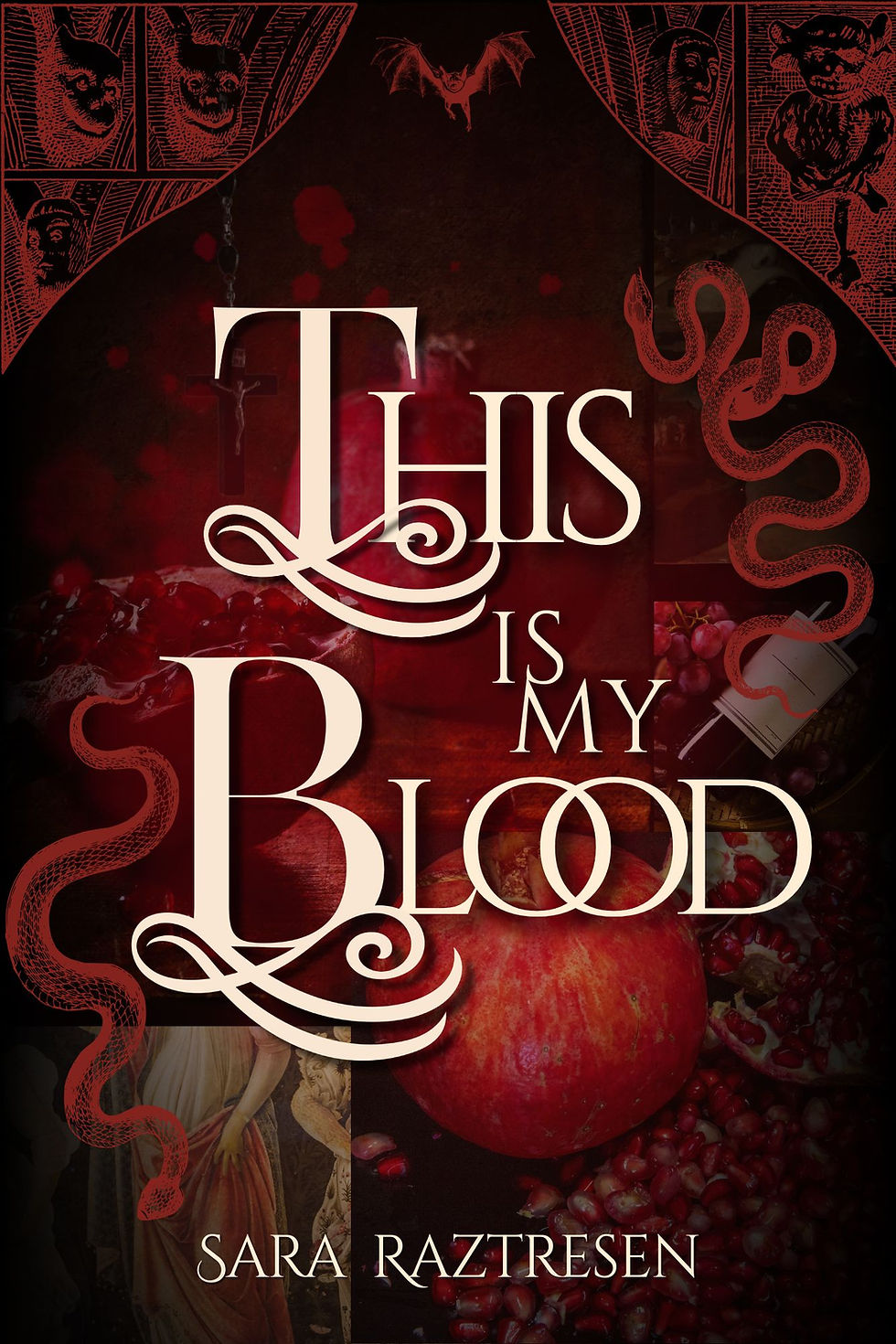
Genuinely, truly, I could not be more excited about this book. It is about so many things: my twenties, my relationship with God, my understanding of who I should be vs. who I am... and it draws on so much of what I've learned as a witch, both literally and theologically.
So if you liked what you read here today, and you want to support the work I do in general, I'd appreciate you to the moon and back if you read the rest of their story. It's my best work to date, in my opinion—and God willing, I'll say that about every work I write from here on out.

Sara Raztresen is a Slovene-American writer, screenwriter, and Christian witch. Her fantasy works draw heavily on the wisdom she gathers from her own personal and spiritual experience, and her spiritual practice borrows much of the whimsy and wonder that modern society has relegated to fairy-and-folktale. Her goal is to help people regain their spiritual footing and discover God through a new (yet old) lens of mysticism.


Comments