


How an Occultist Uses Her Knowledge to Research and Write Fiction | A Christian Witch's Writing Process

The zany stuff I get up to actually does help quite a bit lol.

Psst, hey! Did you know? This post was originally from my Patreon, and if you head over there, you'll find a lot more content like this every week, all while further supporting the work I do!
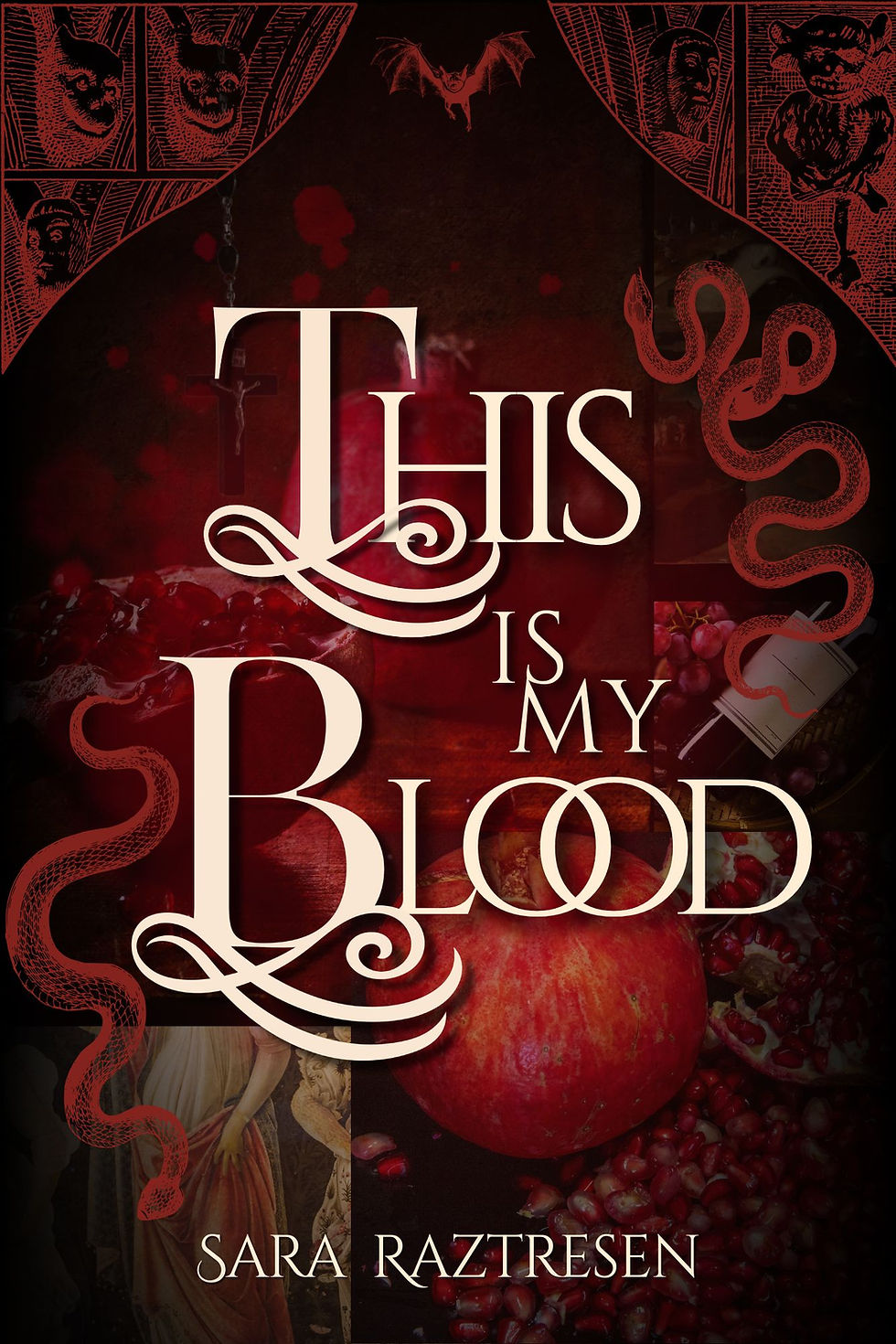
But with my first stand-alone novel, This is My Blood, almost here, I had to let y'all in on my background process of getting this book going. I'm saying I wrote this book in six months, and that's because I'm counting from when I started actually putting words on paper to when I completed it—but if I include the research process, that actually brings us more to about 7-8 months. And researching is the most fun part, so let's talk about it!
(And by the way... this book comes out July 31st, so if you were looking to pre-order and get a snazzy little art card of the two main characters to go with it... now's the time.)
It was double important that I tell you about this, also, because when I'd written this post, I had recently learned of a certain person claiming to be a creative writer who "doesn't research." Because all their story ideas "come from their own life experiences."
Crazy, right?
Unfathomable to me, honestly. Half the fun of building any story is that you can get outside yourself while still talking about and sharing your own feelings/experiences. Like, do I know anything about Greece? Have I ever been to Amsterdam? Am I Polish? NO. But is the main witch character in This is My Blood dealing with a lot of the struggles I'm currently dealing with or have dealt with regarding relationships and progress in life? And is the vampire a little mix of my fiance's outlook with the general symbol of "false life" / faithlessness / fear of death? OF COURSE. Because you can wrap your own ideas and messages into things that aren't directly about you; you can infuse lessons into stories that extend outside your frame of reference.
In fact, I dunno; I think it would be incredibly stifling to not do this. And the things I could talk about based on my own 28 years of life, while storied to an extent, would inevitably be more myopic than if I... you know... expanded my brain out to other perspectives, places, cultures, lives, languages, etc.
Moreover, researching for TIMB has also made me appreciate real-world stories in a way I never thought I would as a staunch high fantasy enjoyer. I really never thought I'd be writing a book in our world, or doing magical realism, but man... in the research, I discovered just how much cool shit already exists in this world to work with! Like, oh my God! How could I not use these systems that already exist to talk about these ideas? Not everything has to fit in a neatly packaged metaphor like fantasy can so often become (which is what we see in my first series, The Glass Witch, what with the four continents pretty opaquely representing four major regions of the world).
Anyway, when it came to TIMB, let me tell you a little of what I researched to pool everything together.
My General Approach to Book Prep
First things first, I should say: when I prepare to write a book, I always have to prepare the basic background of what it is I'm going to wrap my own themes, messages, and arguments in. In fact, there's something to be said about the idea that even fiction has a "thesis," or, in more fiction-friendly speak, a "moral." What am I arguing with the book? What am I trying to explain or demonstrate/illustrate? Though I generally don't like to go moral-first into writing because I think it can get real preachy real fast, so I go theme-first. Themes are neutral. I want the book to be about XYZ—but what about XYZ is something that develops organically with the characters and the plot. I do this because I don't want to spoonfeed the lesson to my readers; I want them to be able to break it apart and put it back together on their own.
But! Regardless, I know that I have my own opinions about XYZ, and therefore I am going to sneak my own arguments and ideas into the discussion in tasteful ways. Because nothing can exist that doesn't say something. Even if my characters follow the logical consequences to their actions and reactions, they're characters I built to be a certain way, and therefore to act a certain way, for a reason. They experience the consequences that they should, by virtue of their actions, of course—I don't believe in plot armor or in pulling punches in my writing—but where we start dictates where we end.
And that means I need to have my own ideas pre-loaded, or built off the peripheral studies that make up my day to day. It also means that depending on what I'm writing and arguing (for instance: a more academic text like Discovering Christian Witchcraft), I'll have to get some "basics" under wrap—enough information on a topic to build the beginning outline and framework of whatever it is I'm arguing.
For Discerning Christian Witchcraft, this meant reading books like The Crucified God, Magic in Christianity from Jesus to the Gnostics, What Paul Really Said About Women, and all those other more basic ones, to create the outline. It took about three months to read enough to where I felt comfortable starting the whole book, and even then, the reading didn't stop because the writing started. I'd find places where I needed more context or more information and make a note to find relevant books and essays on those topics to fill in later, all while the whole book was taking shape.
But in general, that is my rule: 2-3 months of plotting and outlining before getting into the writing. In the case of my upcoming end-of-year book, A Hitchhiker's Guide to Hell, this is more like one month to fill in the gaps of my own experience and what I already know, but that's because I've already done a lot of the work in the process of doing my Qliphoth stuff.
Area of Research 1: Vampire Lore (History, Folklore, & Dramatic Angst)
With that process down, naturally, the first thing I had to do was get into the genre of vampires (fiction and folklore wise) again. This meant looking at vampire romances or classic vampire tales, as well as the lore of certain famous shows I used to love (like True Blood or The Vampire Diaries), and cross-referencing that with real vampire lore (such as the folklore behind what makes vampires happen, the famous vampires that have gone down in legend like Jure Grando or Jacques St. Germain, and different vampire-adjacent creatures like the Polish strzyga and Greek empousa).
I had to figure out a few things: what was going on with my vampires—both in terms of spiritual/physiological mechanics and in the lore that brought them into being—and what was going on with them spiritually/psychologically/romantically. As such, after trawling around many pages and folklore sites and whatnot about vampires, I also read books like Heather Guerre's Hot Blooded (a more standard vampire romance that I actually liked, even if there was a lot that was goofy with it lol) and Anne Rice's Interview with the Vampire series. That latter one, I actually read all along my research/writing/revising journey, and that especially highlighted the psychological aspects that I wanted to hit.
I dunno how Anne Rice did it. But Jesus, did she make some believably angsty vampires.
However, it wasn't just vampires and their general creation myth that I had to look into. I had to also weave the vampire backstory together in a way that would explain how he got to where he was in the first place. And because I couldn't help myself and really wanted to make Vlad III (or Vlad Tepes, or Vlad Dracula) a part of this, that meant I had to make some leaps that could reasonably connect into a vampire origin story.
Which meant I had to look into Vlad Dracula, as well as his father Vlad Dracul, and the larger conflict they were wrapped up in with the Ottoman empire under Mehmed II. This had nothing to do with vampires and everything to do with understanding how my vampire came to become a vampire in the first place, and lucky me, everything with Dracula worked out perfectly. Because wouldn't you know: Dracula was actually held hostage to make his dad stay in line when he was a kid, meaning he grew up in present-day Turkey (and likely had a not-super-awesome-time despite being educated there and still brought up like some vague nobility bc naturally you can't go too crazy when trying to get your vassal state to behave).
Know what's in Turkey AKA the Ottoman Empire? Anatolia. Know who had massive cult sites in Anatolia? Hekate. Know which daimones were her servants, said to go shapeshifting and drinking the blood of humans? The empousai.
Bada-bing, bada-boom. The lore all connects: Greece, as part of the Ottoman empire, would have had to give up their sons under the Ottoman devshirme system. That's how our Greek boy gets caught up in the Ottoman army. And then ends up in Dracula's cellars, who ran off in secret and got some crazy power from an old cult rite, which effectively transformed him into an empousa and made it so he could make more of the same.
(And then of course, I also had fun thinking of how different origin points for vampires, like being buried wrong or being under a witch's curse, would change the secondary powers/traits of a vampire lineage, which led to the concept of Houses and keeping vampires together by their House/progenitor. Fun stuff.)
Area of Research 2: Polish Folk Magic
Now, secondly, I had to do just a tiny bit more digging into Polish folk magic, because I'm not Polish. I'm Slovenian. They're both Slavic cultures, but folk magic varies massively town to town, village to village, nevermind nation to nation. For this, it was much more straightforward: I read Polish Folk Magic by Joanna Tarnawska, a fantastic overview of these folk traditions, and I also drew a lot on my own knowledge of Catholic folk magic/folk charms.
This was a lot less intensive than the vampire bit lol. It already exists! It's already pre-loaded! This was more something I could play with and use to make certain points rather than anything that I had to do all kinds of dot-connecting with, like the vampire thing. That and the fact that this is a Polish-American person meant that I didn't have to know all too much about Poland directly, but enough about the diaspora and folk magic, which I also know about by virtue of living in Rhode Island and patronizing the Polish markets and such lol.
Area of Research 3: WTF Does a Vineyard Owner Do?
Now, this was probably my favorite part of research. I had also been reading a bit of billionaire romance to see what the hell was going on with the romances between Obviously Not Rich Girl™ and Super Rich Guy™ (like in Kyra Parsi's A Deal with a Bossy Devil), and what I found was that... there's never really any actual descriptions of what the guys are doing that make them so rich? Like maybe they have one meeting with shareholders or something, and then the rest just feels like... an excuse for them to be able to run around and have fun experiences with no consequence or care for resources lol. (Which I suppose is part of the point, but... no. That just feels cheap to me. As cheap as how in ACOTAR, magic just became a fancy way to get out of having to explain how anything actually works in the world lmao.)
I wanted my vampire to be a vineyard owner, not only because it would be a good way to launder all the money/riches he'd stolen/collected from his victims through the ages, but also because we have vineyards in Rhode Island, and it seemed like the most prudent way to hide a ton of blood for "night clients" coming around looking for a drink without causing legal trouble and panic in the streets. But what does a vineyard owner do? I had no idea, and I didn't even know where to start googling that shit, so what I did instead was shoot my shot.
I e-mailed a few vineyards and asked if anyone would be willing to talk to me for half an hour or so about this, and to my surprise, I got a bite! The owner of Newport Vineyards answered a bunch of my questions about what it takes to own a vineyard, how they run their front end business (both the restaurant side and the storefront), how they take care of the vines, get their wines into stores, etc. I specifically asked what the owner does, too, and it seems like it's a lot of coordinating all the different pieces between different managers (event managers, marketing managers, contracts with distributors, etc.) as well as being the liaison between the farmers tending the grapes and the folks actually making the wine in the wineries (as sometimes they have to harvest early if they think it'll be a bad frost, or sometimes they have too many grapes to process and need to slow down the harvesting, etc.).
Area of Research 4: Understanding the Streets
And lastly, my in-person research included going around Providence, where the Witch works, and seeing the sites she would see, as well as the types of bars or upscale places the vampire would be taking her to, and how bartenders work (because she works as a bartender on Westminster Street—my favorite street in Providence). Getting the right vibe, soaking up the atmosphere at night, running all over... that was the most fun. The less fun stuff was sitting on Google maps calculating driving times and bus routes and all that, but actually researching the vibes was a fantastic excuse to run wild with my own mans, who is my own vampire, as cheesy as that is.
(We went bar hopping and pub crawling for seven hours. It was such a fun night. And I found so many cool bars and areas that had the perfect tone for the book.)
And that's how I researched for TIMB especially, but it's definitely how I approach research in general, whether for fiction or nonfiction. It's the part that makes me feel like I can travel the world without actually going very far, and that's part of what I love so much about writing. ♥

Sara Raztresen is a Slovene-American writer, screenwriter, and Christian witch. Her fantasy works draw heavily on the wisdom she gathers from her own personal and spiritual experience, and her spiritual practice borrows much of the whimsy and wonder that modern society has relegated to fairy-and-folktale. Her goal is to help people regain their spiritual footing and discover God through a new (yet old) lens of mysticism.


Comments